
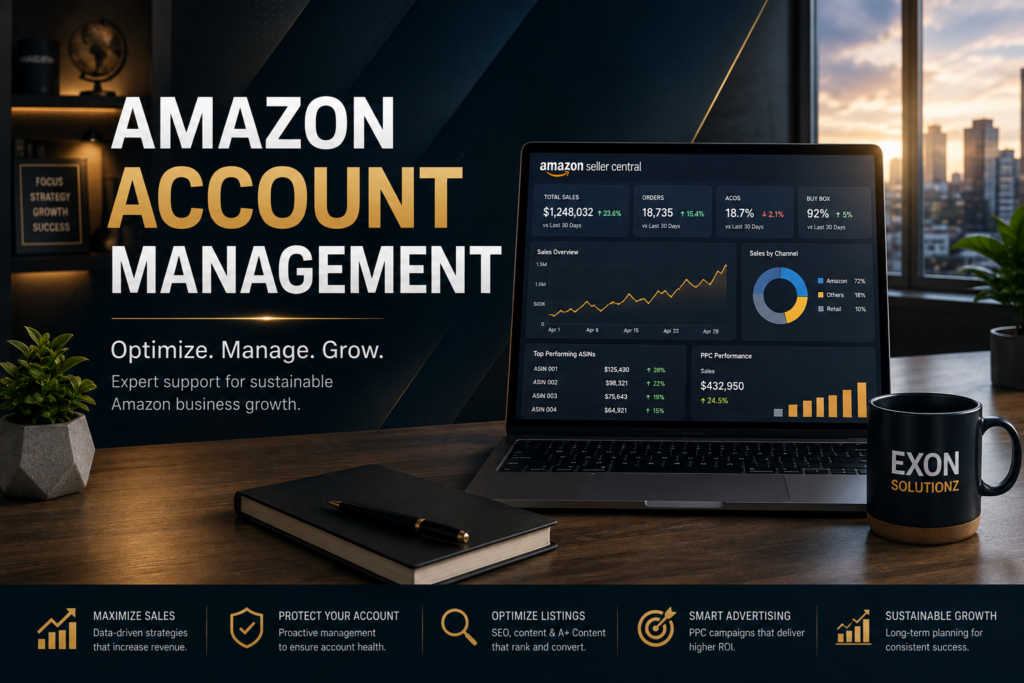
If you’ve ever felt like your Amazon store is running you instead of the other way around, you’re not alone. Between listing updates, PPC bids, inventory forecasts, account health warnings, and a customer service inbox that never seems to empty, most sellers reach a point where they’re managing chaos rather than growing a business. That’s exactly the gap Amazon account management is built to close.
This guide breaks down what Amazon account management actually involves, why it matters more in 2026 than it ever has, and how the right support can turn a stagnant listing into a predictable revenue engine. Whether you’re a private label brand doing six figures a year or a wholesale seller managing hundreds of SKUs, you’ll find practical, no-fluff answers here.
What is Amazon Account Management?
Amazon account management is the ongoing, hands-on process of running and optimizing every operational and strategic piece of a seller’s Amazon business listings, advertising, inventory, account health, customer experience, and reporting so the account grows steadily instead of drifting on autopilot.
It’s easy to confuse account management with a single service like PPC or listing optimization. In reality, it’s the umbrella that holds everything together. A skilled Amazon account manager doesn’t just fix one problem; they watch the entire account the way a business owner would, spotting issues before they become suppressions, and catching opportunities before a competitor does.
Think of it less as a task list and more as a discipline. Amazon’s algorithm, policies, and advertising auctions shift constantly. Without someone actively managing the account, even a well-launched product can quietly lose rank, get flagged for a policy violation, or bleed ad spend on keywords that stopped converting months ago.
Why Amazon Sellers Need Professional Account Management
Amazon is not a “set it and forget it” platform. It rewards sellers who are consistently active and quietly punishes the ones who aren’t.
Here’s what’s changed in recent years that makes professional Amazon seller account management less of a luxury and more of a necessity:
- Advertising has gotten more expensive and more complex. Sponsored Products, Sponsored Brands, Sponsored Display, and now AI-driven campaign types all require different strategies.
- Account health enforcement is stricter. Policy violations, IP complaints, and listing suppressions can happen with little warning.
- Competition has multiplied. Categories that had a handful of sellers five years ago now have hundreds, many running aggressive pricing and ad strategies.
- Amazon’s algorithm rewards consistency. Listings that are optimized once and never touched again tend to plateau or decline.
- Buyers expect more. Reviews, A+ Content, and brand story sections now directly influence conversion rate and conversion rate influences organic rank.
For a seller trying to run all of this alone while also sourcing product, managing suppliers, and handling finances, something eventually slips. That’s usually where accounts start losing money without anyone noticing until the monthly numbers come in.
Callout: The Real Cost of Neglect A single week of an unoptimized PPC campaign can waste hundreds or even thousands of dollars in wasted ad spend. A single account health strike, left unaddressed, can suspend an entire business. Account management isn’t overhead it’s insurance plus growth strategy combined.
What Does an Amazon Account Manager Do?
An Amazon account manager acts as the operational brain behind your storefront. Their job touches nearly every part of the business, broken down into daily, weekly, and monthly rhythms.
Daily Responsibilities
- Monitoring account health and performance notifications
- Checking and adjusting PPC bids and budgets
- Responding to customer messages within Amazon’s required window
- Reviewing inventory levels and restock alerts
- Watching for listing suppressions, hijackers, or buy box loss
- Tracking daily sales and ad spend trends
Weekly Responsibilities
- Analyzing PPC campaign performance and adjusting keyword strategy
- Reviewing search term reports to add negative keywords
- Checking competitor pricing and listing changes
- Updating inventory forecasts and reorder points
- Reviewing customer reviews and flagging issues for follow-up
- Auditing listing content for accuracy and compliance
Monthly Responsibilities
- Full account performance reporting
- Deep-dive PPC strategy review and budget reallocation
- Listing optimization updates based on search term data
- A+ Content and brand store review
- Inventory planning tied to seasonality and promotions
- Strategic planning calls with the brand owner
Complete Amazon Account Management Checklist
Use this as a working checklist, whether you’re managing your account yourself or evaluating whether an agency is covering everything they should be.
✔ Account Health & Compliance
- Account health dashboard reviewed weekly
- Policy violations addressed within 24-48 hours
- IP complaints monitored and disputed when necessary
- Order defect rate kept within Amazon’s targets
✔ Listings & SEO
- Titles, bullet points, and descriptions optimized with keyword research
- Backend search terms fully utilized
- A+ Content live on all eligible ASINs
- Images meet current Amazon specifications
✔ Advertising
- Campaign structure organized by match type and goal
- Negative keywords added weekly
- ACOS and TACOS tracked against targets
- New keyword opportunities tested monthly
✔ Inventory & Operations
- Reorder points calculated based on sales velocity
- FBA storage limits and fees monitored
- Stranded or suppressed inventory resolved quickly
✔ Customer Experience
- Messages answered within Amazon’s response window
- Negative reviews addressed and, where valid, escalated
- Return and refund patterns reviewed for root causes
✔ Reporting & Strategy
- Monthly performance report delivered
- Growth plan updated based on data, not guesswork
Table 2: Daily, Weekly, and Monthly Tasks at a Glance
| Frequency | Key Tasks |
|---|---|
| Daily | Account health checks, PPC bid monitoring, customer message responses, inventory alerts, buy box tracking |
| Weekly | Search term analysis, negative keyword additions, competitor checks, review monitoring, listing audits |
| Monthly | Full reporting, PPC strategy overhaul, A+ Content updates, inventory forecasting, growth strategy calls |
15 Benefits of Hiring an Amazon Account Management Agency
- Frees up your time to focus on product development and sourcing instead of daily fire-fighting.
- Reduces costly mistakes that come from inexperience with Amazon’s policies.
- Improves organic rank through consistent, data-backed listing optimization.
- Lowers wasted ad spend with active PPC management instead of “set and forget” campaigns.
- Protects account health with proactive monitoring instead of reactive damage control.
- Speeds up problem resolution because agencies know exactly how to escalate issues with Amazon support.
- Brings category-specific expertise from working across multiple brands and niches.
- Improves conversion rate through better images, A+ Content, and brand storytelling.
- Provides objective reporting so you always know what’s working and what isn’t.
- Scales with your business without you needing to hire and train an internal team.
- Keeps you compliant with Amazon’s constantly changing terms of service.
- Strengthens brand presence through Brand Registry, Storefronts, and A+ Content.
- Improves inventory planning, reducing both stockouts and excess storage fees.
- Gives access to enterprise-level tools most individual sellers wouldn’t invest in alone.
- Delivers a long-term growth strategy, not just short-term fixes.
DIY vs Freelancer vs Amazon Agency
This is the decision every growing seller eventually faces. Here’s an honest comparison.
DIY vs Freelancer vs Agency
| Factor | DIY (Seller Manages It) | Freelancer | Amazon Agency |
|---|---|---|---|
| Expertise Depth | Limited to what you’ve learned | Varies widely, often single-skill focused | Full team across PPC, SEO, creative, and operations |
| Time Investment | Very high | Moderate — still requires oversight | Low — agency handles execution |
| Cost | “Free” but high opportunity cost | Low to moderate | Moderate to higher, but ROI-focused |
| Consistency | Inconsistent, dependent on your bandwidth | Depends on freelancer’s workload | Structured processes and accountability |
| Scalability | Difficult to scale alone | Limited by one person’s capacity | Built to scale with your business |
| Risk Management | High risk of missed compliance issues | Moderate depends on experience | Lower risk, proactive monitoring |
| Best For | Very small, early-stage sellers | Sellers needing one specific task done | Brands serious about long-term growth |
There’s no universally “wrong” choice here a brand-new seller testing their first product might reasonably start DIY. But once revenue climbs and the account becomes more complex, the cost of mistakes almost always outweighs the cost of professional management.
Common Amazon Account Management Mistakes
Even experienced sellers fall into these traps:
- Ignoring account health until it’s a crisis. By the time a listing is suppressed, the damage is already showing up in sales.
- Running PPC campaigns without regular optimization. Budgets get set once and never revisited, even as performance drifts.
- Treating listings as “finished.” Amazon’s search algorithm rewards freshness and relevance, not a listing written once and left untouched.
- Reacting instead of forecasting inventory. Stockouts kill organic rank; overstock triggers long-term storage fees.
- Responding to negative reviews emotionally instead of strategically.
- Not separating brand strategy from daily operations, so nobody is thinking about the next 12 months.
- Underusing A+ Content and Brand Registry tools that are often already available but never activated.
Common Problems vs Professional Solutions
| Common Problem | Professional Solution |
|---|---|
| Listing suppressed with no clear reason | Agency identifies root cause and files a compliant appeal |
| PPC spend climbing with flat sales | Bid restructuring and negative keyword cleanup |
| Inconsistent inventory, frequent stockouts | Sales-velocity based reorder planning |
| Reviews trending negative | Root-cause analysis tied to product or fulfillment issues |
| Organic rank slowly dropping | Full listing SEO refresh using updated search term data |
| No clear growth plan | Monthly strategy sessions tied to real performance data |
How Amazon Account Management Improves Sales
Sales growth on Amazon rarely comes from one big change it comes from dozens of small, consistent improvements compounding over time. That’s the core value of ongoing account management.
How Account Management Supports PPC
Professional Amazon PPC management means campaigns are structured with intent from day one separating branded, competitor, and generic keyword campaigns so budget isn’t wasted chasing the wrong searches. From there, it’s a constant cycle of bid adjustments, negative keyword additions, and testing new placements like Sponsored Brands video or Sponsored Display retargeting.
The goal isn’t just lower ACOS it’s a healthy balance between advertising cost and overall account growth, often tracked through TACOS (Total Advertising Cost of Sales), which reflects how efficiently paid traffic is fueling total revenue, including organic sales lifted by ad visibility.
How Account Management Improves SEO
Amazon SEO isn’t a one-time task. It’s an ongoing process of refining titles, bullet points, backend search terms, and A+ Content based on real customer search behavior. A good account manager continually mines search term reports from PPC campaigns to discover the exact language customers use then feeds that language back into the organic listing.
This is where account management and advertising genuinely support each other: PPC data improves SEO, and stronger SEO reduces dependence on paid traffic over time.
Inventory, Customer Service, and Account Health
Inventory Management Nothing kills momentum like a stockout right after a listing finally starts ranking well. Account managers track sales velocity, lead times, and seasonality to keep stock at the right level not too little, not so much that storage fees eat into margin.
Customer Service Response time and resolution quality directly affect account health metrics and, indirectly, conversion rate through reviews. Professional management means messages are answered promptly and consistently, following Amazon’s communication guidelines.
Account Health This is the foundation everything else sits on. Order defect rate, policy compliance, and customer service metrics are monitored continuously, because a suspended account makes every other strategy irrelevant.
Performance Metrics, Reporting, and Scaling
Good account management runs on data, not guesswork. The metrics that matter most typically include:
- Total sales and unit velocity
- Conversion rate by ASIN
- ACOS and TACOS
- Organic vs paid sales ratio
- Inventory performance index (IPI)
- Customer return and refund rates
Reporting should happen monthly at minimum, translating raw numbers into a clear narrative: what worked, what didn’t, and what’s changing next. Scaling strategies then build on that data whether that means expanding into new marketplaces, launching complementary products, or increasing ad investment in categories that are already performing well.
Case Study Example
The situation: A mid-sized private label brand selling home goods had been on Amazon for two years, generating steady but stagnant revenue. PPC spend was climbing every quarter with almost no corresponding sales growth, and two of their top listings had lost significant organic rank.
What changed: A full account audit revealed outdated backend search terms, an untouched PPC campaign structure from launch, and no A+ Content on their two best-selling ASINs. Over the following 90 days, listings were rebuilt around updated keyword research, A+ Content was added across the catalog, and PPC campaigns were restructured around performance data rather than guesswork.
The result: Organic rank recovered on both flagship listings, ACOS dropped meaningfully as wasted spend was cut, and overall monthly revenue moved into consistent growth for the first time in over a year. The turning point wasn’t one single fix it was the compounding effect of consistent, month-over-month account management.
Who Should Hire an Amazon Account Manager?
Professional account management makes sense for:
- Private label brands looking to scale past their current plateau
- Wholesale sellers managing large, complex catalogs
- Brand owners who want to protect and grow their reputation on the platform
- Startups launching their first products who want to avoid early, costly mistakes
- Growing Amazon businesses that have outgrown DIY management but aren’t ready for a full in-house team
- E-commerce entrepreneurs running multiple brands or storefronts who need consistent, reliable execution across all of them
If your account is generating meaningful revenue but your time is stretched too thin to manage it properly, that’s usually the clearest sign it’s time to bring in professional support.
How to Choose the Right Amazon Agency
Not all agencies are equal, and the wrong partner can do real damage to an account. Here’s what to look for:
- Transparent reporting. You should always know exactly what’s being done and why.
- Category experience. Ask if they’ve worked with brands similar to yours.
- No unrealistic promises. Be cautious of anyone guaranteeing specific rank positions or overnight results that’s not how Amazon’s algorithm works.
- Full-service capability. Look for a team that handles SEO, PPC, creative, and operations together, rather than juggling multiple disconnected vendors.
- Clear communication. Regular calls and accessible points of contact matter more than most sellers realize until they’re missing.
- References and case studies. A reputable agency should be able to show real, verifiable results.
Future of Amazon Account Management
Amazon’s ecosystem is only getting more sophisticated. AI-powered advertising tools, evolving search algorithms, and increasing competition mean that account management in 2026 and beyond will require even more proactive strategy than it did just a few years ago. Sellers who treat their Amazon business like a business with dedicated, consistent management will be the ones who keep winning shelf space and customer trust as the platform keeps evolving.
Final Thoughts
Amazon rewards consistency, and it punishes neglect quietly and gradually, which is exactly why so many sellers don’t notice a problem until it’s already affecting revenue. Professional Amazon account management isn’t about outsourcing busywork it’s about having someone actively protecting and growing your business every single day, using the same tools, data, and strategy that top-performing brands rely on.
If you’re spending more time firefighting than growing, it might be time for a different approach.
Frequently Asked Questions
1. What is Amazon account management?
Amazon account management is the ongoing process of overseeing a seller’s listings, advertising, inventory, account health, and customer service to keep the business compliant, competitive, and growing.
2. How much does Amazon account management cost?
Pricing varies by agency and scope of work, typically depending on catalog size, ad spend, and the range of services included, such as SEO, PPC, and creative work.
3. Do I need Amazon account management if I only sell a few products?
Smaller catalogs still benefit, especially in competitive categories, but the need becomes more urgent as revenue, SKU count, and ad spend grow.
4. What’s the difference between an Amazon account manager and a PPC specialist?
A PPC specialist focuses solely on advertising, while an account manager oversees the entire account, including listings, inventory, compliance, and strategy.
5. Can account management help recover a suspended Amazon account?
Yes. Experienced account managers understand Amazon’s policies and appeal processes, which significantly improves the chances of a successful reinstatement.
6. How often should my Amazon listings be updated?
Listings should be reviewed at least monthly, with updates made whenever new keyword data, seasonal trends, or performance issues call for changes.
7. What is TACOS and why does it matter?
TACOS (Total Advertising Cost of Sales) measures ad spend against total revenue, showing how efficiently advertising is contributing to overall business growth.
8. Does Amazon account management include inventory management?
Yes, most full-service account management includes inventory forecasting and planning to prevent stockouts and reduce excess storage fees.
9. How long does it take to see results from professional account management?
Some improvements, like fixing account health issues, can show results within days, while SEO and organic rank improvements typically take 60-90 days to fully materialize.
10. Is DIY Amazon account management realistic for growing brands?
It’s possible early on, but as complexity increases, most growing brands find that professional management prevents costly mistakes and frees up time for higher-level business decisions.
11. What should I look for in an Amazon account management agency? Look for transparent reporting, relevant category experience, full-service capabilities, and realistic expectations rather than guaranteed results.
12. Does account management improve Amazon SEO?
Yes, consistent account management directly supports SEO through ongoing keyword optimization, A+ Content updates, and data pulled from advertising performance.
Ready to Grow Your Amazon Business the Right Way?
Running a successful Amazon business takes more than a good product it takes consistent, expert management across every part of your account. At Exon Solutionz, our team handles the full picture: Amazon Account Management, Amazon SEO, Amazon PPC, Listing Optimization, A+ Content, Brand Registry support, Inventory Management, and long-term Growth Strategy all under one roof.
If you’re ready to stop firefighting and start scaling, let’s talk. Contact Exon Solutionz today and find out what a dedicated Amazon account management team can do for your brand.