
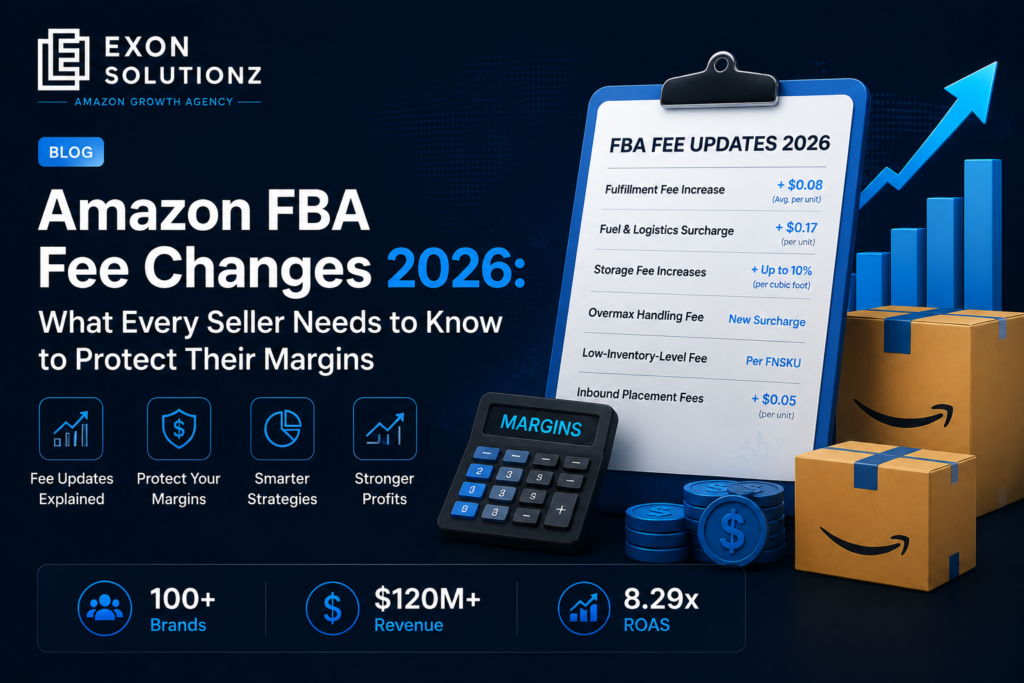
Amazon FBA Fee Changes 2026 are reshaping seller margins across the USA, UK and UAE marketplaces. Amazon has introduced a series of FBA fee changes that while appearing modest on the surface are quietly eroding profitability for thousands of sellers who have not recalculated their unit economics.
At Exon Solutionz, we manage PPC campaigns and full Amazon accounts for 100+ brands across the USA, UK, and UAE. We have seen firsthand how these fee changes are impacting our clients’ bottom lines and more importantly, we have developed the strategies to protect and even grow margins despite these increases.
In this guide, we break down every significant FBA fee change in 2026, what it actually means for your business, and the specific strategies we use for our clients to offset these costs and stay profitable.
According to Amazon Seller Central, these changes took effect January 15, 2026.
Amazon FBA Fee Changes 2026 | Complete Breakdowns
1. Fulfillment Fee Increase Effective January 15, 2026
Amazon increased FBA fulfillment fees by an average of $0.08 per unit effective January 15, 2026. While Amazon describes this as “less than 0.5% of an average item’s selling price,” the real impact compounds quickly at scale.
Here is how the increases break down by price tier:
Products Under $10:
- Small standard-size products see an increase of approximately $0.12 per unit
- Amazon did increase the Low-Price FBA discount to $0.86 (up from $0.77) to partially offset this for ultra-low-priced items
Products Between $10 and $50:
- Small standard items: increase of approximately $0.25 per unit
- Large standard items: smaller increase of approximately $0.05 per unit
- This is the price range where most mid-market brands operate and feel the most impact
Products Over $50:
- Premium products face the steepest increases
- Small standard items: increase of approximately $0.51 per unit
- Large standard items: increase of approximately $0.31 per unit
- Amazon attributes this to higher processing costs and enhanced services for high-value goods
What this means at scale: If you are selling 1,000 units per month at the $10-$50 price range, that is an additional $80 to $250 per month in fees before accounting for any other changes. At 10,000 units per month, you are looking at $800 to $2,500 in additional monthly costs. Multiply that across multiple SKUs and the numbers become significant very quickly.
2. The April 2026 Fuel and Logistics Surcharge A Second Hit
Just when sellers thought the January increases were the end of it, Amazon announced a 3.5% fuel and logistics surcharge on all FBA fulfillment fees, effective April 17, 2026.
For most US sellers, this works out to approximately $0.17 extra per unit on top of the January increases.
Amazon cited elevated costs in fulfillment and logistics driven by rising fuel prices as the reason for this additional charge. Combined with the January increases, sellers are now paying an average of $0.25 more per unit than they were in 2025 a figure that adds up to hundreds of thousands of dollars annually for high volume sellers.
At Exon Solutionz, we began advising our clients to recalculate their unit economics immediately after this announcement to identify which SKUs were at risk and take corrective action before margins eroded.
3. Storage Fee Increases
Amazon also adjusted storage fees for 2026:
- Monthly storage fees (January to September): Increased from $0.75 per cubic foot to $0.82 per cubic foot
- Monthly storage fees (October to December): Increased from $2.40 per cubic foot to $2.63 per cubic foot — the critical Q4 period when inventory levels are highest
- Long-term storage fees: Increased from $6.90 per cubic foot to $7.56 per cubic foot for items stored for more than 365 days
If you store 1,000 cubic feet of inventory for 12 months, the new storage fee structure adds approximately $660 in additional annual costs. For brands with large catalogs or slow-moving inventory, this impact is even more pronounced.
4. Overmax Handling Fee New Surcharge for Large Items
Amazon introduced a new “Overmax Handling Fee” for extra-large products where the longest side exceeds 96 inches or the length plus girth exceeds 130 inches.
If you sell tall, long, or oddly shaped products poles, tubing, sporting equipment, furniture — this new surcharge applies to you. It is charged per unit on top of standard FBA fees and catches many sellers off guard who previously just paid the standard oversized fulfillment fee.
5. Low-Inventory-Level Fee Now at FNSKU Level
This is one of the most operationally impactful changes of 2026. Amazon has shifted the Low-Inventory-Level Fee calculation from the parent ASIN level to the individual FNSKU level.
Previously: Amazon assessed low inventory by looking at all variations of a parent product combined. If one variation was overstocked, it could offset another variation that was running low.
Now: Each individual FNSKU is assessed separately. Child SKUs that were previously balanced by other variations in your catalog may now trigger low-inventory fees on their own.
For brands with product variations different colors, sizes, or bundled versions this change demands tighter SKU-level inventory management than most sellers have historically practiced.
6. Inbound Placement Fees Minimal Shipment Splits Increase
The cost of getting inventory into Amazon’s fulfillment network continues to rise. Fees for “Minimal Shipment Splits” sending inventory to just one warehouse location have increased by an average of $0.05 per unit for standard items.
To avoid these fees, sellers must use the “Amazon-Optimized” split option, which distributes inventory to five or more fulfillment center locations and remains fee-free.
7. SIPP Program New Packaging Fee for Non-Participants
Amazon’s Ships in Product Packaging (SIPP) program has become increasingly important in 2026. Products in certain size tiers that are not enrolled in SIPP will now incur a new packaging fee averaging $2.07 per unit to cover the cost of Amazon boxing them.
For bulky or heavy items that ship in their own box, SIPP certification is now essential. This is not a minor fee — $2.07 per unit on a product doing 500 monthly sales adds $1,035 to your monthly costs.
The Real Impact: How Much Are You Actually Losing?
Let us put these numbers together for a typical mid-market Amazon brand doing 5,000 units per month in the $15 to $40 price range:
| Fee Change | Per Unit | Monthly Impact (5,000 units) |
|---|---|---|
| January fulfillment increase | +$0.08 | +$400 |
| April fuel surcharge | +$0.17 | +$850 |
| Storage fee increase | Varies | +$200-500 |
| Total estimated impact | +$0.25+ | +$1,450-1,750/month |
That is $17,400 to $21,000 in additional annual costs for a brand doing just 5,000 units per month. For high-volume sellers, this number grows proportionally.
How Exon Solutionz Helps Clients Protect Margins in 2026
At Exon Solutionz, we do not just track fee changes we build strategies that protect and grow our clients’ margins regardless of what Amazon changes. Here is how we approach this for the brands we manage:
Strategy 1: SKU-Level Profitability Modeling
The 2026 fee changes make SKU-level profitability analysis non-negotiable. We build detailed unit economics models for every SKU we manage, recalculated every time Amazon adjusts its fee structure. This allows us to immediately identify which products are at risk and take corrective action whether that means repricing, bundling, or removing underperforming SKUs from FBA.
Strategy 2: Inventory Planning to Eliminate Low-Inventory Fees
With the FNSKU-level Low-Inventory Fee now in effect, we implement tight reorder point systems for every variation in our clients’ catalogs. We monitor sell-through rates daily and set up automated alerts when any individual FNSKU is at risk of triggering a low-inventory penalty.
Strategy 3: SIPP Enrollment for Eligible Products
For every client with bulky or large-format products, we assess SIPP eligibility immediately. The $2.07 per unit packaging fee is one of the most avoidable costs in 2026 enrolling in SIPP takes effort upfront but pays back quickly for any product doing meaningful volume.
Strategy 4: Amazon-Optimized Inbound Splits
We configure all client inbound shipments to use Amazon-Optimized splits to eliminate the Minimal Shipment Split surcharge. While this requires more operational coordination, the fee savings at scale more than justify the added complexity.
Strategy 5: PPC Efficiency to Offset Margin Compression
When fees go up, advertising efficiency becomes even more critical. We optimize our clients’ PPC campaigns specifically to reduce ACOS in response to fee increases because every dollar saved on advertising directly offsets the additional fee burden. Our current client average ACOS is 12.1%, well below the industry average, which gives our clients a meaningful margin advantage even as fees rise.
Strategy 6: Pricing Strategy Recalibration
Fee increases do not always mean you need to raise prices but in many cases, a modest price adjustment is the most straightforward solution. We run price elasticity analysis for our clients to identify when and how much to increase prices without impacting conversion rate or sales rank. In most cases, a $1 to $2 price increase on a well-ranked product has minimal impact on conversion while fully recovering the fee increase.
What You Should Do Right Now
If you have not already taken action on the 2026 fee changes, here is what to do immediately:
This week:
- Download your FBA fee report from Seller Central and calculate your total fee increase per SKU
- Identify any products not enrolled in SIPP that are incurring the new packaging fee
- Review your inventory levels at the FNSKU level and flag any variations at risk of low-inventory fees
This month:
- Recalculate your unit economics for every active SKU using the new 2026 fee structure including the April surcharge
- Review your PPC campaigns and identify opportunities to reduce ACOS to offset the fee compression
- Assess your inbound shipment configuration and switch to Amazon-Optimized splits where possible
This quarter:
- Implement a formal SKU-level profitability review process that updates automatically with every fee change
- Consider consolidating your catalog by removing or delisting chronically underperforming SKUs that are now unprofitable under the new fee structure
The Bottom Line
The 2026 Amazon FBA fee changes are not catastrophic on their own but they are the latest in a series of incremental cost increases that are compressing margins for sellers who are not actively managing their unit economics.
The brands that will win in 2026 are not the ones with the lowest fees they are the ones with the most disciplined operations, the most efficient advertising, and the most precise inventory management. These are exactly the competencies that Exon Solutionz brings to every account we manage.
If you want to know exactly how the 2026 fee changes are impacting your specific catalog and what strategies will protect your margins, we offer a completely free Amazon account audit with zero commitment. Our team will analyze your fee exposure, identify your biggest margin risks, and build a custom action plan to protect and grow your profitability in 2026.
Get Your Free Amazon Audit Today →
No commitment. Just an honest assessment of your fee exposure and a clear plan to protect your margins.
Contact Exon Solutionz:
Exon Solutionz is a results-driven Amazon Growth Agency. We have managed 100+ brands and generated $120M+ in revenue for our clients across 15+ marketplaces. Our team specializes in Amazon PPC, SEO, listing optimization, full account management, and logistics management.