
Building a 7-figure Amazon brand in 2026 is not the long shot it used to be. Thousands of US sellers cross the $1 million mark every year. But the brands that get there and stay there are not the ones with the flashiest products or the biggest launch budgets. They are the ones running tight operational systems across every function of their business simultaneously.
Amazon has become the most competitive retail marketplace on the planet. Over 2.5 million sellers are active on the platform at any given time. Every profitable category has established competition, aggressive private label entrants, and increasingly sophisticated advertising from both domestic and international brands. Simply listing a good product and hoping it ranks is no longer a viable strategy.
What separates a 7-figure Amazon brand from a brand that stalls at $200K or $400K is not a single breakthrough. It is consistent, disciplined execution across product selection, Amazon listing optimization, Amazon advertising, inventory management, and brand positioning all working together.
This guide breaks down exactly how to build a 7-figure Amazon brand in 2026, step by step. Every section reflects what is actually working right now, not what worked three years ago.
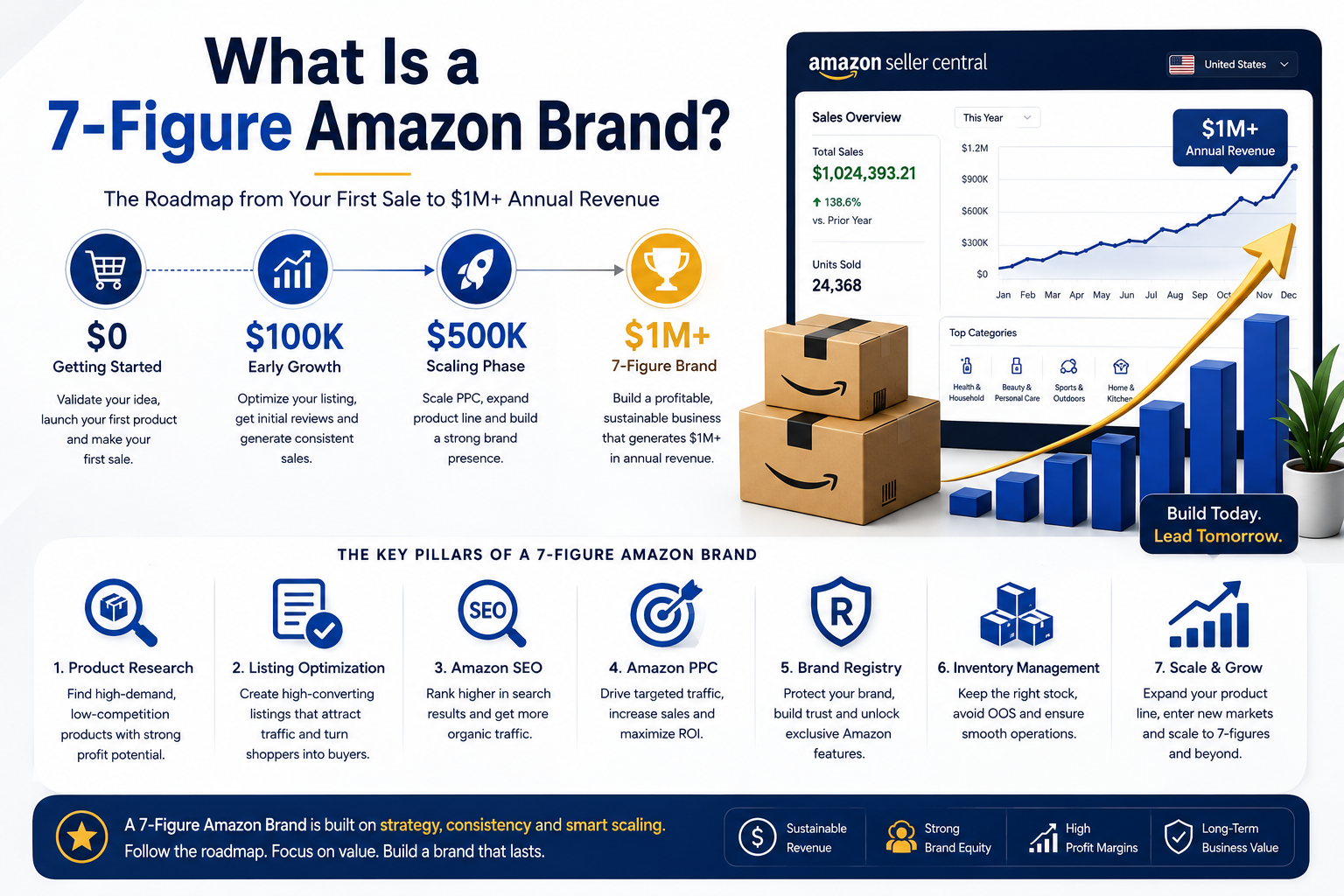
What Is a 7-Figure Amazon Brand?
Definition: A 7-figure Amazon brand is a seller account or private label brand generating between $1,000,000 and $9,999,999 in annual Amazon revenue. It typically operates with Brand Registry, multiple SKUs or product lines, consistent organic rankings, a structured Amazon advertising setup, and documented operational processes across inventory, creative, and customer experience.
The definition matters because “7 figures” gets thrown around loosely. Revenue is not profit. A brand doing $2 million in revenue with a 10% net margin is making $200,000 — the same as a brand doing $800,000 at 25%. Understanding where you are on the revenue-to-profit spectrum is the first discipline that separates serious brands from those chasing vanity numbers.
The Reality Behind 7-Figure Revenue
To reach $1 million in annual Amazon revenue, you need approximately $83,000 in monthly sales. That sounds manageable and it is but it requires multiple things to work at the same time.
Net margins for healthy 7-figure Amazon brands typically run between 20 and 30 percent after cost of goods, FBA fees, Amazon advertising spend, and software costs. Below 20 percent, you have very little buffer when Amazon changes its fee structure which it did again in January 2026, with some fulfillment costs rising by up to $0.51 per unit for heavier items.
| Revenue Level | Monthly Target | Required Avg. Net Margin | Monthly Net Profit |
|---|---|---|---|
| $500K/year | ~$42K | 25% | ~$10,500 |
| $1M/year | ~$83K | 25% | ~$20,750 |
| $3M/year | ~$250K | 22% | ~$55,000 |
| $5M/year | ~$417K | 20% | ~$83,400 |
The uncomfortable truth: most brands that plateau before $1M are not suffering from a product problem. They are suffering from a systems problem. Revenue growth amplifies whatever is broken in your operation it does not fix it.
Step 1 Product Selection That Supports a Real Brand
Expert Insight: After working with dozens of Amazon brands, the single most predictable indicator of whether a seller reaches 7 figures is product line potential at the research stage. Sellers who pick one good product to test and build from almost always outperform those who chase the highest-volume keyword with a generic item.
The criteria for a 7-figure product are not the same as the criteria for a 6-figure product. At the $1M+ level, you need products that can support an entire brand identity not just a listing.
Product Selection Criteria for 7-Figure Scale:
- Retail price above $30. Anything lower creates margin compression that is almost impossible to escape under 2026 FBA fulfillment rates.
- A category with expansion potential. You need room to launch 2–3 complementary SKUs within 18–24 months.
- Real differentiation materials, design, bundling strategy, or packaging not just a logo swap on an existing product.
- A review profile that can realistically be competed with. Entering a category where the top three listings have 10,000+ reviews each requires a very long, expensive ramp.
- Demand consistency. Seasonal products can be profitable, but 7-figure brands typically have at least one evergreen product generating stable monthly revenue.
⚠️ Warning: Chasing “winning products” based on viral Amazon tool screenshots is one of the fastest ways to burn through capital. By the time a product shows up on trending charts, dozens of competitors have already ordered inventory. Focus on sustainable niches, not trending spikes.
Step 2 Amazon Listing Optimization That Converts
Definition: Amazon listing optimization is the process of improving every element of a product detail page title, bullet points, description, A+ Content, images, and backend search terms to improve both search visibility and conversion rate. An optimized listing ranks higher in Amazon’s search results and converts more of the traffic it receives into sales.
Your listing is not just a product page. It is your entire sales team working 24 hours a day across every device your customer uses.
Over 60 percent of Amazon traffic now comes from mobile devices — roughly 126 million people browsing and buying via phone every month. If your title is cut off on a 5-inch screen, your first bullet point is buried, or your main image does not communicate the product within half a second, you are losing the majority of your potential customers before they even read a word of your copy.
Listing Optimization Checklist:
- Title contains primary keyword within the first 5 words
- Title is readable on mobile (under 80 characters visible on most devices)
- Main image is on pure white background, product fills 85%+ of the frame
- Secondary images include lifestyle, scale reference, infographic, and in-use context
- Product video present (brands with video see significantly higher conversion rates)
- All 5 bullet points lead with a benefit, not a feature
- A+ Content is live and includes comparison module or brand story
- Backend search terms are fully utilized (250 bytes maximum) with non-duplicate keywords
- Brand Storefront linked from listing
Best Practice: Write bullet points for someone who has already decided they want this type of product and is now comparing yours to three competitors. Your job is not to explain what the product is it is to explain why yours wins.
A+ Content deserves its own focus. Basic A+ is available to all Brand Registry sellers, but Premium A+ (available to sellers meeting Amazon’s volume thresholds) unlocks interactive modules, comparison charts, and enhanced video integration. If you have access to Premium A+, use it. The conversion lift is real and consistently documented across categories.
For a deeper walkthrough of what separates a converting listing from a listing that just exists, see our Amazon listing optimization guide.
Step 3 Amazon SEO and Organic Ranking
Definition: Amazon SEO is the practice of optimizing product listings to rank higher in Amazon’s internal search results. Amazon’s ranking algorithm evaluates keyword relevance, sales velocity, conversion rate, customer satisfaction signals, and listing completeness to determine which products appear at the top of search results for any given query.
A note on the algorithm: you will often see references online to something called the “Amazon A10 algorithm.” It is worth being clear here Amazon has never officially confirmed the existence of a specific algorithm called A10. This is an industry term that emerged from seller community observations about shifts in how Amazon appeared to weight certain signals, particularly external traffic and organic sales velocity, relative to paid sales. It is a useful shorthand for discussing ranking signal changes, but it should not be treated as officially documented fact.
What Amazon has been clear about, and what sellers consistently observe in practice, is that conversion rate is one of the most powerful ranking signals. A listing that gets 1,000 impressions and converts 8% of them will outrank a listing that gets 1,000 impressions and converts 3%, everything else being equal.
Amazon Organic Ranking Factors (Observed, Not Officially Confirmed by Amazon):
| Signal | Impact Level | Notes |
|---|---|---|
| Keyword relevance (title, bullets, backend) | High | Foundation — must be right before everything else |
| Conversion rate | High | Directly tied to listing quality and price competitiveness |
| Sales velocity | High | Consistent daily sales outperforms spiky sales history |
| Review count and rating | Medium-High | Social proof affects conversion, which affects ranking |
| Click-through rate from search results | Medium | Main image and price drive CTR |
| External traffic | Medium | Amazon rewards brands that bring in off-platform visitors |
| Inventory availability | Medium | Stockouts damage ranking disproportionately to the duration |
| FBA vs FBM | Low-Medium | FBA provides Prime badge and faster delivery, which lift conversion |
The practical implication: Amazon organic ranking is not purely an SEO exercise. It is a conversion optimization exercise. Fix the listing first, then drive traffic to it.
Step 4 Amazon PPC Strategy That Scales Profitably
Definition: Amazon PPC (Pay-Per-Click) is Amazon’s internal advertising system, accessed through Amazon Seller Central, that allows sellers to bid on keywords and product placements to show sponsored ads in search results and on product detail pages. Sellers pay only when a shopper clicks their ad. Amazon advertising is one of the primary drivers of both immediate sales and organic ranking improvement.
The Amazon advertising landscape in 2026 is more layered than it has ever been. Brands now need to manage Sponsored Products, Sponsored Brands, Sponsored Display, video ads, and for larger budgets DSP (Demand-Side Platform). Each format serves a different function in the funnel.
Expert Tip: Many sellers make the mistake of treating Amazon PPC as a single lever spend more, get more sales. In reality, PPC is a collection of levers, each with different functions. Sponsored Products drive direct keyword sales. Sponsored Brands build visibility and capture top-of-search placement. Sponsored Display creates retargeting touchpoints. Brands that run all three in a coordinated strategy consistently outperform those running Sponsored Products alone.
ACoS vs TACoS Why Both Matter:
| Metric | Formula | What It Tells You |
|---|---|---|
| ACoS | Ad Spend ÷ Ad Revenue × 100 | Efficiency of your advertising in isolation |
| TACoS | Total Ad Spend ÷ Total Revenue × 100 | Health of your advertising relative to your whole business |
A brand with an ACoS of 35% and a TACoS of 8% is in excellent shape most revenue is organic, ads are supporting visibility without being the primary driver. A brand with an ACoS of 35% and a TACoS of 30% has a serious organic ranking problem and is over-dependent on paid traffic to generate sales.
PPC Campaign Structure Best Practices:
- Separate branded, competitor, and generic keyword campaigns. Each requires different bidding logic and performance expectations.
- Use exact match campaigns to protect your most profitable keywords from broad match dilution.
- Run auto campaigns perpetually at a controlled budget to capture new keyword discovery.
- Audit search term reports weekly add converting terms to manual campaigns, negative match irrelevant terms immediately.
- Never pause a campaign that is profitable because of budget concerns. Reduce bids first; pause as a last resort.
For brands ready to build a structured Amazon advertising setup, our Amazon PPC management service covers full campaign architecture and ongoing optimization.
Step 5 Margin Protection at Every Stage
Most brands scaling toward $2M, $5M, or $10M make a version of the same mistake. They assume the approach that got them to $1M will carry them further. More ad spend, more SKUs, more headcount and suddenly they are doing three times the revenue with half the profit margin.
⚠️ Warning: Scaling on Amazon is a margin compression exercise if you do it without a framework. Revenue growth increases every cost in your business COGS at volume, inbound shipping, storage, return processing, and advertising. Without deliberate margin management at each stage, growth can actually make a business less financially stable.
Target margins by business stage:
- Early stage (under $500K revenue): Accept lower margins (15–20%) while building velocity and reviews
- Growth stage ($500K–$2M): Target 22–28% net margin this is where most margin compression happens
- Scale stage ($2M+): Protect 25–30% net below this, the business becomes fragile
Amazon’s January 2026 FBA fee update (Amazon’s current FBA fee schedule) increased fulfillment costs on heavier items by up to $0.51 per unit. If your margin model has not been recalculated since last year, run those numbers again before your next inventory order.
Margin Protection Checklist:
- Full landed cost calculated per SKU (product cost + freight + duties + FBA fee + return rate)
- Advertising cost modeled as a percentage of revenue, not a fixed dollar amount
- Pricing reviewed against current FBA fee structure (Amazon publishes updated fee tables in Seller Central)
- Return rate tracked and factored into net margin for each product
- Storage fees monitored aged inventory costs compound quickly
Step 6 Inventory Systems That Protect Your Ranking
Stockouts are among the most damaging events that can happen to an Amazon product ranking. When inventory hits zero, Amazon suppresses the listing from search results almost immediately. The organic ranking position you spent weeks or months building can erode within 48 hours of going out of stock. Rebuilding that position after restocking often takes two to four weeks of strong sales velocity during which you are usually relying heavily on paid traffic to recover.
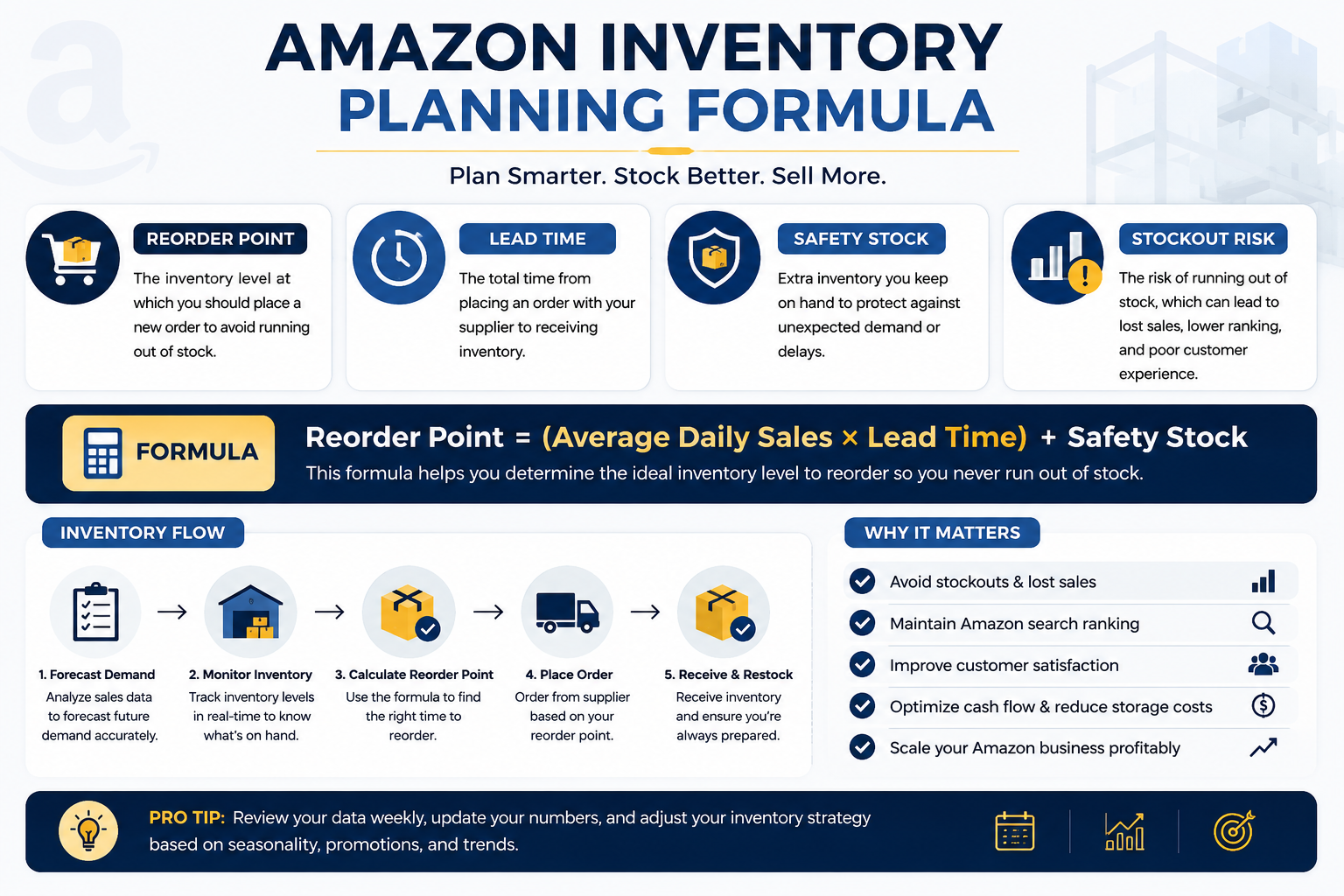
The standard inventory planning formula:
Reorder Point = (Average Daily Sales × Lead Time in Days) + Safety Stock
For most Amazon brands, safety stock should represent 20 to 30 percent of the lead time demand quantity. As you scale and your sales velocity increases, the absolute cost of carrying safety stock increases but the cost of a stockout increases faster.
Expert Insight: The sellers who never stock out are not necessarily the ones with the most capital. They are the ones who set up Seller Central restock alerts, track inventory health weekly, and maintain supplier relationships that allow for expedited orders when demand spikes unexpectedly. Systems beat capital every time.
Amazon’s inbound placement fees, introduced in 2024 and updated in 2025, now make inventory planning a direct margin decision. Sending inventory to multiple FBA fulfillment centers costs more upfront but typically reduces per-unit storage costs and improves delivery speed both of which affect conversion rate and ranking.
Review your inventory health report in Amazon Seller Central at least once per week. Stranded inventory, unfulfillable units, and excess stock all create silent margin leaks that compound over time.
Step 7 Amazon Brand Registry and Brand Tools
Definition: Amazon Brand Registry is a free program for sellers who own a registered trademark. It unlocks access to enhanced listing tools including A+ Content, Amazon Storefront, Brand Analytics, Sponsored Brands advertising, Amazon Posts, Brand Gating, and the ability to report and remove counterfeit listings. Brand Registry is the foundation of brand protection and growth on Amazon.
For any seller building a 7-figure Amazon brand, Brand Registry is not optional. Without it, you cannot access the tools that differentiate a brand from a commodity listing.
Brand Registry Unlocks:
| Tool | What It Does |
|---|---|
| A+ Content / Premium A+ | Enhanced product detail page with visual modules, comparison charts, brand storytelling |
| Amazon Storefront | Dedicated brand page — functions like a mini-website within Amazon |
| Brand Analytics | Search frequency rank, market basket analysis, demographic data |
| Sponsored Brands | Top-of-search banner ads linking to Storefront or custom landing page |
| Amazon Posts | Social-style content feed visible on competitor listings and category pages |
| Brand Gating | Prevents unauthorized resellers from listing on your ASINs |
| IP Accelerator | Faster trademark registration support for brand protection |
The Storefront deserves specific attention. Most sellers set it up once and never update it. This is a missed opportunity. An actively maintained Storefront functions as the destination for Sponsored Brand campaigns, the hub for Amazon Posts content, and the primary brand impression for any shopper who clicks your brand name from a listing. Treat it like a landing page, not a formality.
Step 8 Knowing When to Bring in Expert Support
In 2026, managing a 7-figure Amazon brand requires coordinated expertise across advertising, listing optimization, account health, creative production, inventory management, and compliance monitoring. For most brand owners, trying to own all of these functions personally is the ceiling on their growth not the market.
The brands that scale to $3M, $5M, and beyond are consistently the ones that identify their weakest function and address it with the right support before it becomes the bottleneck.
For many brands, that means working with an experienced Amazon growth agency at specific inflection points — particularly when PPC performance starts declining relative to ad spend, when listings are not converting at the expected rate despite strong traffic, or when account health issues begin emerging at scale.
If you are at a point where operational complexity is limiting your growth, the Amazon account management team at Exon Solutionz works directly with brand owners to identify and close the specific gaps between where a brand is and where it should be.
Common Mistakes That Stall Amazon Brands Before 7 Figures
Understanding what not to do is equally important as knowing the playbook. Here are the most consistent patterns that stop otherwise promising brands before they reach seven figures:
1. Launching without enough reviews Going live with fewer than 15–20 reviews dramatically reduces conversion rate, which tanks organic ranking before it has a chance to build. Use Amazon Vine, follow-up email sequences via buyer-seller messaging, and product inserts (within Amazon’s terms) to accelerate early review acquisition.
2. Treating PPC as a profit center instead of a growth engine In the early stages of a product launch, PPC is expected to run at a loss. Sellers who cut campaigns because of negative ACoS in the first 60 days often kill the ranking momentum they just paid to build.
3. Underpricing to compete Chronic discounting trains your audience to wait for deals, damages perceived brand value, and destroys the margin that funds future growth. Price for profitability and compete on value.
4. Single-SKU dependency A 7-figure brand needs multiple revenue streams. A single ASIN generating all revenue means one competitor, one review attack, or one supply chain disruption can cut revenue in half overnight.
5. Ignoring account health Performance notifications, policy warnings, and A-to-Z claim spikes are ignored until they trigger a suspension. By that point, recovering can take weeks and cost significant revenue. Review your account health dashboard in Amazon Seller Central weekly.
6. Not building external traffic Amazon’s algorithm rewards products that bring in off-platform traffic. A basic email list, Instagram presence, or even a modest influencer relationship can create a meaningful edge in organic ranking for competitive keywords.
7-Figure Amazon Brand Checklist
Foundation
- Trademarked brand enrolled in Amazon Brand Registry
- Product line potential validated (2–3 complementary SKUs planned)
- Landed cost and target margin calculated per SKU before ordering
- Supplier relationship established with expedited order capability
Listing
- Title optimized for primary keyword and mobile display
- All secondary images: lifestyle, infographic, scale reference, in-use
- A+ Content live with comparison chart or brand story module
- Product video uploaded
- Backend keywords fully populated (250 bytes, no duplication)
Advertising
- Sponsored Products campaigns active with exact, phrase, and auto match types
- Sponsored Brands campaign running to Storefront
- Sponsored Display retargeting live
- ACoS and TACoS tracked weekly
- Negative keywords maintained and updated regularly
Operations
- Reorder point formula calculated for each SKU
- Safety stock buffer set at 20–30% of lead time demand
- Inventory health report reviewed weekly in Seller Central
- Stranded inventory process documented and actioned regularly
Brand
- Amazon Storefront active and regularly updated
- Amazon Posts published at least 3–4 times per week
- Brand Analytics reviewed monthly for search frequency rank and market basket data
- Review acquisition process in place (Vine, buyer-seller messaging)
Freuently Asked Questions
Q1. How long does it take to build a 7-figure Amazon brand? Most sellers who reach $1 million in annual Amazon revenue take between 2 and 4 years from first product launch. The timeline depends heavily on starting capital, product selection, how quickly the listing reaches competitive review counts, and the quality of the Amazon advertising strategy in place from the beginning. Brands with strong operational discipline and adequate launch budgets can compress this timeline significantly — but shortcuts in product research or listing quality almost always cost more time in the long run.
Q2. How much capital do I need to build a 7-figure Amazon brand? A realistic starting capital for building toward 7 figures is between $30,000 and $80,000, depending on product category, unit cost, and launch strategy. This needs to cover initial inventory (enough for 90 days of estimated sales), professional photography and A+ Content, Amazon PPC launch budget (expect to run at a loss in the first 60–90 days), and software tools. Underestimating working capital is one of the most common reasons otherwise well-positioned brands stall before reaching meaningful scale.
Q3. What is Amazon Brand Registry and why do I need it? Amazon Brand Registry is a free program for sellers who own a registered trademark on their brand. It unlocks access to A+ Content, Amazon Storefront, Brand Analytics, Sponsored Brands advertising, Amazon Posts, and Brand Gating. These tools are not available to non-registered sellers and are consistently correlated with higher conversion rates, stronger organic rankings, and better brand protection against counterfeit listings and unauthorized resellers. For any seller seriously building toward 7 figures, Brand Registry is a prerequisite, not an optional upgrade.
Q4. What is the difference between ACoS and TACoS? ACoS (Advertising Cost of Sales) is the ratio of your ad spend to your ad-attributed revenue. TACoS (Total Advertising Cost of Sales) is the ratio of your total ad spend to your total revenue — including both ad-attributed and organic sales. TACoS gives you a more accurate picture of how dependent your business is on paid traffic. A brand with a TACoS above 20% is over-reliant on advertising and likely has organic ranking or conversion rate issues that need to be addressed before scaling ad spend further.
Q5. Is Amazon SEO the same as Google SEO? No. Amazon SEO and Google SEO are fundamentally different. Google’s algorithm optimizes for content relevance, authority, and user experience signals across the web. Amazon’s ranking algorithm optimizes primarily for purchase likelihood — it ranks products that are most likely to generate a completed sale. This means Amazon SEO is driven heavily by conversion rate, sales velocity, and keyword relevance within the listing itself, rather than backlinks, domain authority, or content quality. The skills transfer partially, but the strategies are distinct.
Q6. How do I know if my Amazon PPC campaigns are performing well? The best benchmark is TACoS, not ACoS alone. If your TACoS is declining over time while revenue is growing, your organic ranking is improving and you are becoming less dependent on advertising for each dollar of revenue — this is the correct trajectory. A brand should also track impression share on its most important keywords, conversion rate by campaign type, and search term efficiency (what percentage of spend goes to converting search terms versus non-converting ones). Running campaigns without reviewing search term reports weekly means you are almost certainly wasting a portion of every advertising budget.
Q7. What is the Amazon A10 algorithm? The “Amazon A10 algorithm” is an industry term used by sellers and marketers to describe perceived changes in how Amazon’s search ranking system weights different signals — particularly a shift toward rewarding organic sales velocity and external traffic over paid sales velocity. It is important to note that Amazon has never officially confirmed the existence of an algorithm called A10, and the company does not publicly document its ranking algorithm in detail. The term is based on community observations rather than official documentation and should be treated as a useful shorthand, not a confirmed technical fact.
Q8. How many products do I need to reach 7 figures on Amazon? There is no fixed number. Some brands reach $1 million with a single hero product and a handful of variations. Others build to 7 figures with 20 or more SKUs across a category. The more important question is whether each product in your catalog generates positive contribution margin and whether your catalog as a whole reduces dependency on any single ASIN. Single-SKU businesses generating $1M are significantly more fragile than multi-SKU brands at the same revenue level — one review attack, competitor action, or supply chain issue can cut revenue by 80% overnight.
Q9. Do I need an Amazon agency to build a 7-figure brand? Not necessarily — but at certain inflection points, bringing in specialized expertise consistently accelerates results. The most common are: when PPC performance is declining despite increasing spend, when listing conversion rate is not improving despite creative updates, when account health issues are recurring, and when the operational complexity of managing advertising, inventory, and brand tools simultaneously is creating execution gaps. The best agencies do not just manage campaigns — they provide the strategic framework and the data interpretation that most individual sellers do not have time to build internally.
Q10. What is Amazon SEO and how does it affect my product ranking? Amazon SEO is the practice of optimizing your product listing to rank higher in Amazon’s internal search results. The primary factors affecting Amazon product ranking include keyword relevance in the title, bullets, and backend search terms; conversion rate; sales velocity; review count and rating; and inventory availability. Unlike Google SEO, which can take months to show results, improvements in Amazon listing optimization can produce measurable ranking movement within days to weeks, particularly when paired with consistent sales velocity from Amazon PPC advertising.
Conclusion
Building a 7-figure Amazon brand in 2026 is a systems game, not a product lottery. The brands doing it consistently are not necessarily the ones with the best products or the biggest budgets. They are the ones running documented processes across every function product selection, listing optimization, Amazon SEO, advertising strategy, margin management, inventory planning, and brand positioning — with discipline and consistency over time.
The roadmap in this guide works. But reading it and implementing it are two different things.
Start with the checklist in this article. Identify the two or three areas where your current operation has the biggest gaps. Close those gaps before scaling anything else. Revenue growth will always amplify what is already broken fix the foundation first.
If you want an experienced team to audit your Amazon account and show you exactly where your biggest opportunities are, book a free strategy call with Exon Solutionz. We work directly with brand owners to identify the specific levers that move revenue without compressing margins and we bring the operational framework that most brands are missing when they hit their first ceiling.
Seven figures on Amazon is not a question of if. For brands with the right product, the right systems, and the right execution partner, it is a question of when.