
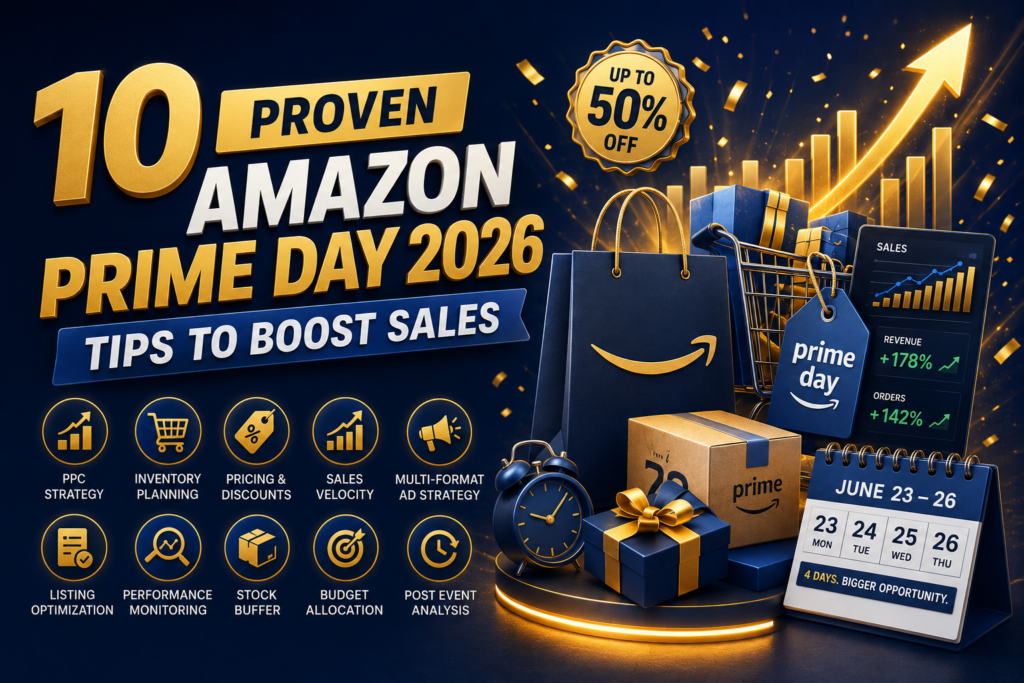
Amazon Prime Day 2026 runs from June 23 to June 26, and for sellers, the difference between a record-breaking event and a missed opportunity almost always comes down to preparation. Having the right products in stock is not enough on its own. The sellers who consistently win during Amazon Prime Day 2026 treat it as a coordinated campaign with multiple moving parts, not a single discount button they flip on the first morning.
Below are 10 proven Amazon Prime Day 2026 tips, based on current advertising data and seller behavior patterns, to help you get the most out of this year’s event.
1. Increase Your PPC Bids for Amazon Prime Day 2026
One of the most common mistakes sellers make is leaving their advertising bids untouched right up until Prime Day begins. Cost-per-click rises sharply once the event starts, and average CPCs on top keywords are expected to reach $2.50 to $8.00 this year, up 15 to 25 percent from 2025. According to Amazon’s own advertising guidance, sellers who adjust bids ahead of high-traffic events consistently see better placement than those who react after the fact. If your bids are not adjusted in advance, you risk losing placement share to competitors who raised theirs early. Review your top exact-match keywords now and increase bids gradually in the days leading up to June 23, rather than waiting until the event is already underway.
2. Run Multiple Ad Formats Together, Not Just One
Sellers who combine Sponsored Products, Sponsored Brands, and Sponsored Display in a coordinated strategy see significantly stronger results than those relying on a single ad type. Data shows a multi-format approach can generate 139 percent more sales compared to single-format campaigns. If your current Amazon PPC advertising setup only uses Sponsored Products, this is the moment to add Sponsored Brands for top-of-search visibility and Sponsored Display to recapture shoppers who viewed your listing but didn’t convert.
3. Build Sales Velocity Before the Event
Amazon’s algorithm rewards products with existing sales momentum. Launching a small coupon or a 5 to 10 percent discount in the weeks before Amazon Prime Day 2026 helps establish that velocity and signals to Amazon that your product is deal-worthy heading into the event. This matters because a large share of shoppers, roughly 75 percent according to recent data, are highly likely to purchase a product they have already discovered before the sale begins. Waiting until June 23 to introduce any discount at all means starting from zero exactly when competitors with pre-built momentum are already pulling ahead.
4. Stock Inventory With a Real Buffer
Running out of stock on day one after paying for a Lightning Deal or a Prime Exclusive Discount is one of the most expensive mistakes a seller can make. If a product sold three times its normal daily volume during a past sales event, plan for at least that same multiplier this year and add a 20 to 30 percent buffer on top. This is also where the earlier 2026 calendar matters most. With inbound shipping deadlines now falling in May instead of June, sellers who delayed restocking decisions may already be working with tighter margins for error than usual.
5. Prioritize Day 1 and Day 4 in Your Budget Planning
Not all four days of Amazon Prime Day 2026 perform equally. Day 1 and Day 4 are typically the strongest in terms of overall sales activity, with Day 1 capturing early high-intent shoppers and Day 4 capturing last-chance buyers before the event closes. Allocate a larger share of your advertising budget to these two days rather than spreading it evenly across all four, and keep slightly more flexible budget available for Day 1 in case performance exceeds expectations.
6. Monitor Performance Every Two Hours During the Event
Once Amazon Prime Day 2026 begins, performance can shift quickly as competitors adjust their own bids and budgets in real time. Checking your campaigns only once a day is not frequent enough during a four-day event with this much volume. Set a habit of reviewing impressions, click-through rate, and ACOS roughly every two hours during peak hours, and be ready to adjust bids immediately rather than waiting for the next day’s report.
7. Improve Listing Quality Instead of Relying Only on Discounts
A deeper discount is not the only way to win a sale. Improving your listing optimization through clearer images, stronger A+ Content, and product video can lift conversion rate without cutting your margin further. This is especially valuable this year, since rising tariffs and stricter deal pricing rules mean some sellers have less room to discount than in past years. A shopper who is on the fence is often swayed more by seeing the product clearly demonstrated than by an extra five percent off.
8. Use Prime Day to Test New Products and Categories
The surge in traffic during Amazon Prime Day 2026 creates a rare opportunity to test how a new product or an unfamiliar category performs under real demand conditions. Selling across a slightly broader range of categories during the event can boost both sales and overall profit, and the data gathered during these four days is often more reliable than weeks of normal-traffic testing, simply because of the volume involved.
9. Increase Budget, Not Just Bids
Many sellers focus heavily on adjusting bids but forget that budget caps can quietly limit performance even when bids are competitive. Plan for a budget that is two to three times your normal daily spend, with flexibility to increase further on campaigns that are clearly outperforming. Budget increases often have a bigger impact on total Amazon Prime Day 2026 sales than bid increases alone, particularly for already well-optimized campaigns.
10. Wait at Least 48 Hours Before Judging Results
After Prime Day ends, resist the urge to evaluate ROAS or overall performance immediately. Attribution data and final order counts typically need at least 48 hours to fully settle. Sellers who pull performance reports too early often see misleadingly low numbers and make hasty changes to campaigns that were actually performing well. Give the data time to stabilize before deciding what worked and what to change for the next event.
Amazon Prime Day 2026 Tips: Bringing It All Together
None of these 10 tips work in isolation. Bid increases without enough budget will hit a ceiling. A strong discount without adequate inventory backup can backfire. Sales velocity built before the event matters far less if your Amazon account management and inventory planning aren’t aligned with the same timeline.
The sellers who consistently perform well during Amazon Prime Day 2026 are the ones who treat these tips as a connected system, starting weeks before the event rather than the morning it begins.
If you want a second set of eyes on your Amazon Prime Day 2026 readiness, including your current PPC structure, inventory buffer, and listing quality, book a free strategy call with our team. We’ll walk through exactly where your biggest opportunities are before the event starts.
New to this year’s event? Start with our overview guide: Amazon Prime Day 2026: Dates, Deals, and What Sellers Need to Know.