
Choosing an Amazon Agency USA for Your Brand
Hiring an Amazon agency is a bigger decision than it looks on the surface. It’s not just outsourcing a task it’s handing over a meaningful part of how your brand is represented, discovered, and sold on the largest marketplace in the country. Get it right, and you free up time while a specialized team handles the parts of Amazon that are genuinely hard to keep up with. Get it wrong, and you can end up paying monthly retainers for work that never moves the needle, or worse, for mistakes that hurt your account health.
Amazon growth today touches a lot of moving parts: SEO, PPC, listing optimization, account management, Brand Registry, creative content, inventory planning, and profitability all at once, all interconnected. The Amazon agency you choose should understand how those pieces fit together, not just specialize in one area and call itself a full-service provider.
Agencies differ widely in how they structure services, communicate, price their work, and how much real Amazon experience sits behind their pitch. This guide walks through what an Amazon agency USA brands typically rely on actually does, when it makes sense to hire one, and — most importantly — how to evaluate your options with real questions and a real checklist, rather than just trusting whoever has the slickest sales page.
What Does an Amazon Agency Do?
A modern Amazon agency typically covers a combination of the following, though the exact mix varies by provider and by client need:
- Amazon account management — day-to-day account health monitoring, case management, and operational oversight
- Amazon SEO — keyword research, listing content, and organic ranking strategy
- Amazon PPC — Sponsored Products, Sponsored Brands, and Sponsored Display campaign management
- Listing optimization — titles, bullet points, descriptions, and images built around both relevance and conversion
- A+ Content — enhanced brand content for eligible listings
- Brand Registry support — helping eligible brands enroll in and use Amazon’s brand protection and content tools
- Brand Store strategy — building and maintaining a brand’s dedicated storefront on Amazon
- Catalog management — organizing parent-child variations, fixing catalog errors, and maintaining listing accuracy
- Inventory coordination — working with sellers to avoid stockouts and excess storage costs
- Reporting and analytics — translating account data into a clear picture of performance
- Conversion rate optimization — improving how well existing traffic turns into sales
- Growth strategy — longer-term planning around new products, marketplaces, or scaling advertising
Not every agency offers all of these under one roof. Some specialize narrowly in PPC. Others focus on creative and listing content but outsource advertising. Understanding this list gives you a framework to ask a very direct question of any agency you’re considering: exactly which of these do you handle in-house, and which (if any) are outsourced or excluded?
When Should a Brand Hire an Amazon Agency?
Not every seller needs an agency, and no honest agency should tell you otherwise. Here are situations where bringing in outside expertise tends to make sense:
- Your internal team doesn’t have deep Amazon-specific expertise. General marketing or ecommerce experience doesn’t always translate directly to Amazon’s specific systems, algorithms, and policies.
- Sales have plateaued despite consistent effort, and you can’t clearly identify why.
- PPC spend is climbing without a corresponding increase in sales.
- Organic rankings are declining and the cause isn’t obvious from the outside.
- Listings are getting traffic but converting poorly.
- Catalog issues suppressed listings, variation problems, compliance flags are consistently eating into internal time.
- You’re expanding into new Amazon marketplaces (Canada, UK, EU) and don’t have in-house experience there.
- The business is scaling toward seven figures and the operational complexity has outgrown what one person or a small internal team can manage well.
- The founder or internal team simply doesn’t have the time to manage Amazon properly alongside everything else running the business.
None of these situations are universal triggers a seller doing steady, healthy six-figure revenue with a lean, capable internal process may not need outside help yet. The honest version of this section is that hiring an agency should solve a specific problem or unlock specific growth you can’t currently achieve internally, not just be something you do because competitors are doing it.
Amazon SEO vs. Amazon PPC Management
These two disciplines are often sold as separate services, but they work best when treated as connected parts of the same growth strategy.
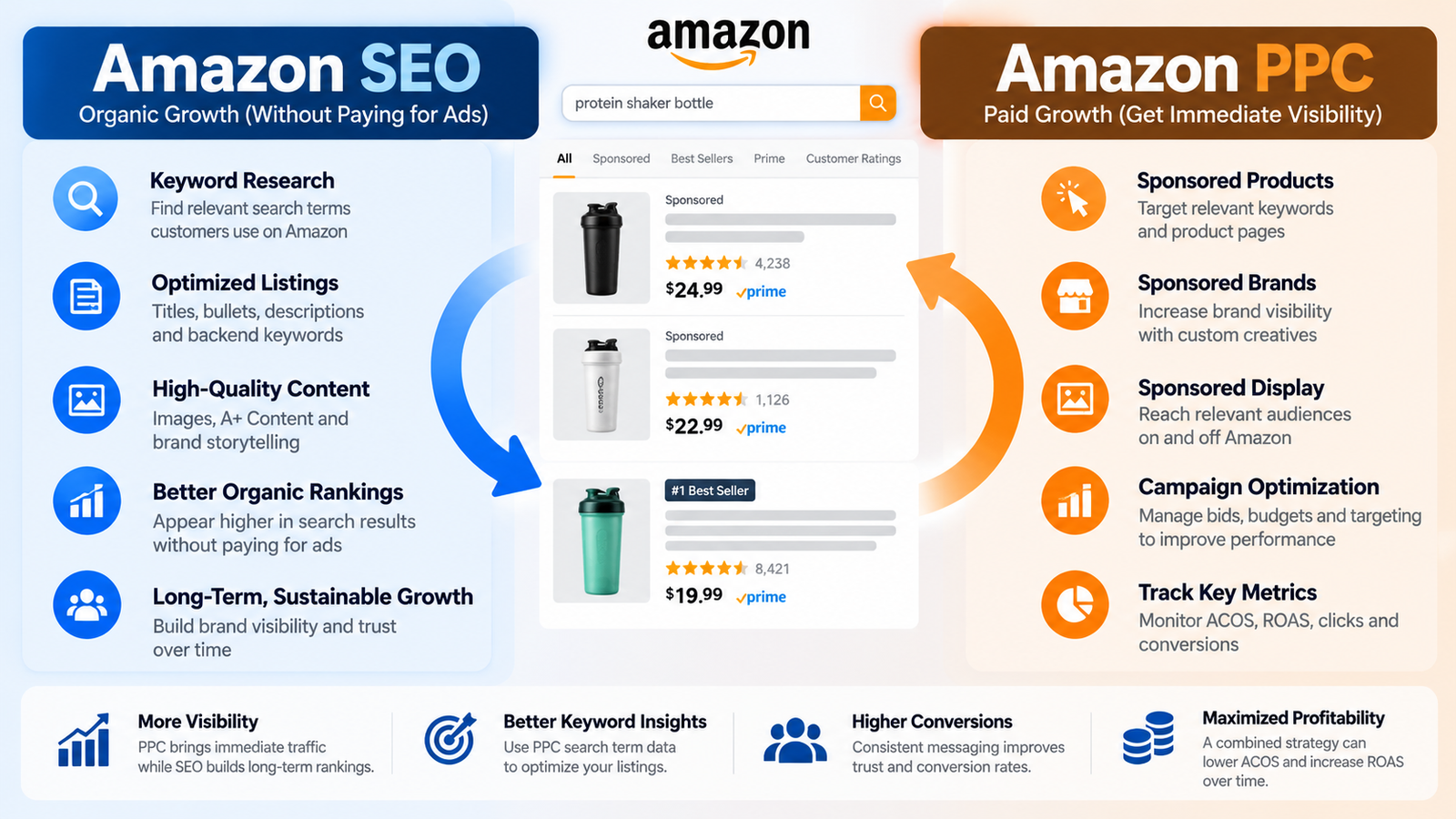
Amazon SEO is about organic discoverability how well your listing ranks in search results without paying for placement. It involves:
- Keyword research based on real buyer language, not just search volume
- Backend search terms that expand relevance without duplicating visible content
- Listing relevance — how well your title, bullets, and description match what shoppers are actually looking for
- Organic ranking, which is influenced by relevance, conversion rate, and overall listing quality
Amazon PPC is paid advertising within Amazon’s ecosystem, primarily through Sponsored Products, Sponsored Brands, and Sponsored Display:
- Sponsored Products — ads for individual listings within search results and product pages
- Sponsored Brands — banner-style ads that can feature multiple products and drive to a Brand Store
- Sponsored Display — ads that can retarget shoppers on and off Amazon
Effective PPC management includes campaign structure (organizing campaigns by match type and goal), ongoing search term analysis, bid optimization, and consistent negative keyword maintenance to cut wasted spend.
A few key metrics agencies should be tracking and explaining clearly:
- ACOS (Advertising Cost of Sale) — ad spend divided by ad-attributed revenue
- ROAS (Return on Ad Spend) — the inverse view, revenue generated per dollar spent
- TACOS (Total Advertising Cost of Sale) — ad spend as a percentage of total revenue, organic and paid combined, which shows how efficiently advertising supports the whole business, not just ad-attributed sales
Here’s why SEO and PPC shouldn’t be managed in silos: your PPC search term reports reveal real, tested customer language phrases people actually searched before buying which is valuable raw material for improving your organic listing content. At the same time, strong organic ranking reduces how heavily you need to rely on paid placement for the same visibility. An agency that only talks about one of these, without connecting it to the other, is likely leaving performance on the table.
Listing Optimization and Conversion Rate
Traffic without conversion is a common, expensive trap. A good agency evaluates a listing holistically, not just for keyword placement:
- Product title — clear, relevant, and structured for both readability and search matching
- Bullet points — specific, benefit-focused content rather than generic claims
- Product description — supporting detail that addresses real buyer questions
- Main image — compliant, high-quality, and immediately clear about what the product is
- Image stack — supporting images that show scale, use case, and key differentiators
- A+ Content — for eligible brands, an opportunity to add richer content and address common objections
- Product positioning — how the listing differentiates from competitors, not just describes the product
- Keyword relevance — content that matches how customers actually search
- Customer objections — whether the listing proactively addresses common hesitations (sizing, compatibility, durability)
- Reviews and ratings — both as a trust signal and as a source of insight into what’s working or not
- Conversion rate — the percentage of visitors who actually purchase
- Mobile experience — how the listing reads and displays on a phone screen, where a large share of Amazon traffic happens
A capable agency will look at conversion rate data before recommending more ad spend. If a listing converts poorly, sending it more traffic just means spending more money to expose the same underlying problem to more people.
Amazon Account Management
Full account management goes beyond any single service and covers the operational health of the account as a whole:
- Catalog health — monitoring for errors, inaccuracies, and compliance issues across all listings
- Variation and parent-child management — keeping product variations correctly structured
- Suppressed listings — identifying and resolving suppression issues quickly
- Account health — monitoring performance metrics that affect standing with Amazon
- Brand Registry issues — managing enrollment status and related brand protections
- Case management — handling support cases with Amazon Seller Support efficiently
- Inventory coordination — working alongside inventory planning to avoid stockouts or overstock
- Performance monitoring — tracking KPIs consistently, not just at report time
- Reporting — translating account activity into a clear picture for the brand owner
- Strategic planning — connecting day-to-day management to longer-term growth goals
This is often the least visible part of what an agency does, but it’s frequently what prevents costly problems a suspended listing, a compliance strike, a stockout during a sales peak — before they happen.
Brand Registry, A+ Content & Amazon Brand Stores
Amazon Brand Registry gives eligible brand owners access to a set of tools intended to help protect their brand and build a stronger presence on the platform, including enhanced content options and reporting tools. Eligibility and specific program details are set by Amazon directly, so any agency should be pointing you to Amazon’s own current requirements rather than making informal claims about who qualifies.
For eligible brands, two tools are particularly relevant to growth strategy:
A+ Content allows for enhanced product description pages with additional images, comparison charts, and formatted text beyond standard bullet points useful for addressing detailed product questions and reinforcing brand identity.
Amazon Brand Stores provide a dedicated, multi-page storefront within Amazon where brands can showcase their full catalog, tell a brand story, and drive traffic from Sponsored Brands ads to a branded destination rather than a single listing.
A knowledgeable agency should be able to explain, based on your brand’s current status, whether Brand Registry enrollment makes sense, and if you’re already enrolled, whether you’re making full use of the tools available to you.
Inventory and Profitability Management
Revenue is only part of the picture. An agency worth working with should be thinking about profitability, not just top-line sales growth. That means understanding the relationship between:
- Inventory planning — forecasting demand accurately enough to avoid both stockouts and excess inventory
- Stockouts — which don’t just lose sales in the moment, but can hurt organic ranking momentum built up before the gap
- Overstock — which ties up cash and increases long-term storage fees
- FBA fees — which vary by product size and season, and directly affect margin
- Advertising costs — which need to be evaluated against actual contribution margin, not just revenue generated
- Contribution margin — what’s actually left after product cost, fulfillment fees, and advertising spend
- TACOS — a useful lens for understanding total advertising efficiency across the business, not just individual campaigns
- Forecasting — planning inventory and cash flow together, especially around seasonal demand shifts
- Cash-flow considerations — since inventory purchases, ad spend, and Amazon payouts don’t always align neatly in timing
An agency that only reports on sales and ad performance, without ever connecting those numbers to actual profitability, is giving you an incomplete picture of how the business is really doing.
How to Evaluate an Amazon Agency
When comparing an Amazon agency USA, look beyond promises and evaluate its experience, reporting, and strategic approach. use this as a working checklist when comparing options. For each point, look for evidence, not just a claim on their website.
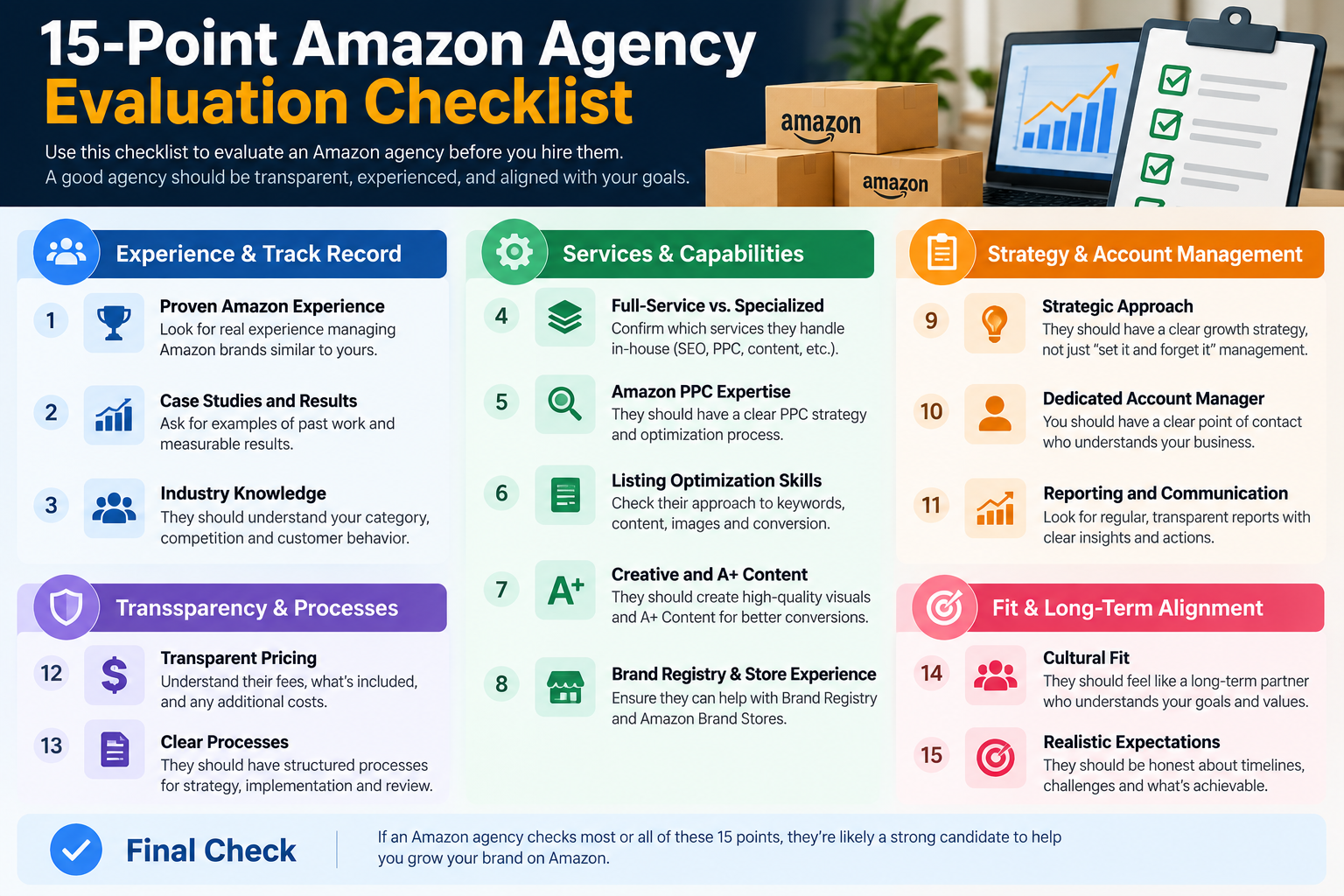
- Relevant Amazon experience — specifically Amazon, not general digital marketing experience.
- Experience with similar brands — your category, price point, and business model matter.
- Marketplace expertise — relevant to the specific Amazon marketplaces (US, and others if applicable) you operate in.
- PPC capabilities — depth across Sponsored Products, Brands, and Display, not just one ad type.
- SEO capabilities — a clear, explainable approach to keyword research and listing optimization.
- Listing optimization — evidence of thoughtful, conversion-focused content work, not templated listings.
- Account management — a real process for monitoring account health, not just advertising.
- Reporting — clear, regular, and tied to KPIs that actually matter to your business.
- Communication — a defined point of contact and response expectations.
- Strategic thinking — can they explain a strategy specific to your brand, or only generic tactics?
- Transparency — willingness to explain what’s working, what isn’t, and why.
- Contract terms — clear scope, clear exit terms, no vague language.
- Team structure — who actually works on your account, and how experienced are they?
- Tools and technology — what software and reporting infrastructure they actually use.
- Understanding of profitability — do they talk about margin and contribution profit, or only revenue and ad metrics?
The pattern across all fifteen: look for specifics. Vague answers to specific questions are one of the clearest warning signs when evaluating any agency.
Questions to Ask Before Hiring an Amazon Agency
Bring these into your first real conversation:
- Which Amazon marketplaces do you actively manage?
- How do you approach Amazon SEO for a brand like ours?
- How do you structure PPC campaigns, and why that structure?
- How frequently do you report, and what does a report actually include?
- Who specifically will manage our account day to day?
- What happens, procedurally, if our sales decline after onboarding?
- How do you handle listing suppressions when they occur?
- How do you approach inventory-related problems, or is that outside your scope?
- Which KPIs do you report on, and which do you consider most important for our situation?
- How do you measure and talk about profitability, not just revenue or ad performance?
- What tools do you use for research, reporting, and campaign management?
- What exactly is included in the monthly fee, and what would cost extra?
- Is there a minimum contract period, and what are the terms to exit?
- How do you communicate with clients — calls, email, a shared dashboard?
- Can you walk us through your proposed strategy before we sign anything?
A capable agency should be able to answer all fifteen clearly and specifically. Hesitation, vagueness, or generic marketing language in response to direct operational questions is worth paying attention to.
Amazon Agency Pricing Models
Pricing structures vary, and each comes with trade-offs worth understanding before you compare quotes.
Flat monthly retainer — A fixed fee regardless of ad spend or revenue. Predictable for budgeting, but make sure the scope of work is clearly defined so “flat fee” doesn’t end up meaning limited attention as your account grows.
Percentage of ad spend — Common for PPC-focused services. Aligns agency incentive with managing ad spend, but can create a subtle incentive to grow spend rather than efficiency if not structured carefully.
Percentage of revenue — Ties agency compensation to overall sales performance. Can align incentives well for growth-focused engagements, but works best with clear definitions of what counts as attributable revenue.
Hybrid pricing — A combination of a base retainer plus a performance-based component. Often used to balance predictability with performance alignment.
Project-based services — A fixed scope and fee for a defined project (a listing overhaul, a Brand Store build, a catalog audit) rather than ongoing management. Useful for a specific, bounded need rather than continuous account management.
There isn’t a universally “best” model the right fit depends on your brand size, marketplace count, advertising budget, and how much ongoing versus project-based work you actually need. Be cautious of any pricing quote given before an agency has actually reviewed your account, category, and goals in any depth.
What Results Should You Expect From an Amazon Agency?
Be skeptical of any agency promising a specific revenue increase or ranking position before they’ve reviewed your brand, category, competition, margins, inventory situation, and advertising history in detail. Amazon outcomes depend on too many variables specific to your business for a responsible agency to guarantee a number upfront.
What you should expect instead is a clear framework for realistic KPIs, which typically include:
- Revenue (both organic and PPC-attributed)
- Organic ranking movement for target keywords
- Sessions and traffic trends
- Conversion rate
- PPC sales and efficiency (ACOS/ROAS/TACOS)
- Buy Box percentage
- Inventory health (stockout rate, excess inventory)
- Contribution margin, not just top-line revenue
- Overall account health status
It’s also worth understanding the difference between short-term improvements (a PPC cleanup reducing wasted spend within weeks) and long-term growth (organic ranking improvements, which typically take longer often measured in months to fully materialize as search behavior and Amazon’s algorithm respond to sustained content and performance changes).
Amazon Agency for 7-Figure Brands
Brands already operating at significant revenue face a different level of complexity than newer sellers, and the right agency partner needs to be equipped for it:
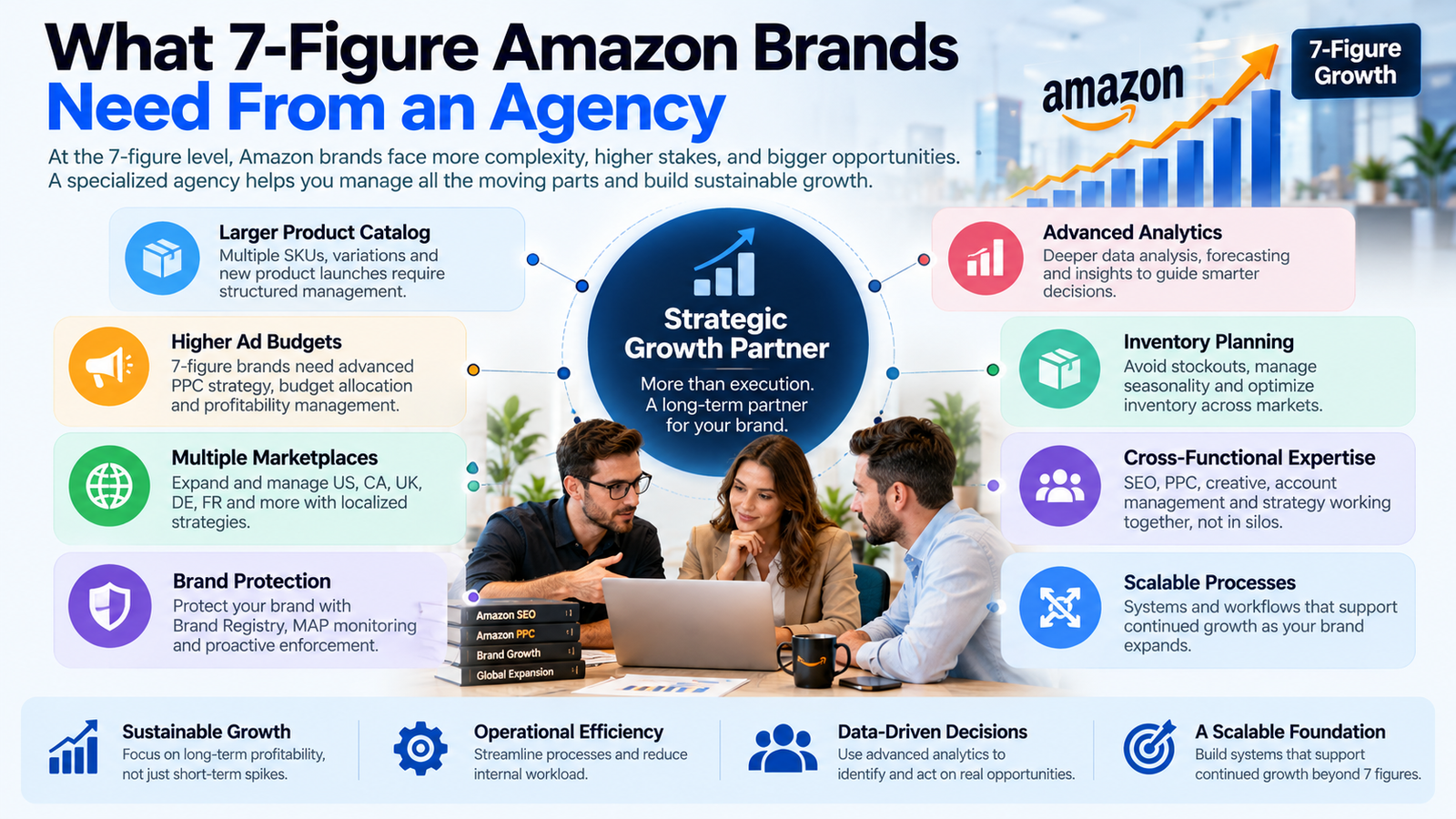
- Multiple SKUs across potentially several product lines, each with its own optimization and advertising needs
- Larger PPC budgets that require more sophisticated structure and monitoring to avoid inefficient spend at scale
- Inventory planning across more SKUs and often longer international supply chains
- International marketplace considerations if the brand is expanding beyond the US
- Brand protection — monitoring for unauthorized sellers, counterfeit listings, and IP issues
- Catalog complexity — more variations, more bundles, more potential for catalog errors
- Forecasting that has to account for larger inventory investments and cash-flow impact
- Profitability analysis that matters more at scale, where small margin inefficiencies compound significantly
- Cross-functional coordination — Amazon strategy increasingly needs to connect with broader brand, retail, or DTC strategy
- Advanced reporting that goes beyond basic dashboards into real business intelligence
At this scale, brands generally benefit from an agency capable of operating as a genuine growth partner — someone thinking about the business holistically rather than a service provider narrowly focused on managing ad campaigns. If you’re building toward this stage, it’s worth reading our related guide, How to Build a 7-Figure Amazon Brand in 2026, which goes deeper into the strategic side of scaling.
How Exon Solutionz Supports Amazon Brands
Exon Solutionz works with Amazon sellers and brands across the core areas covered in this guide: Amazon account management, Amazon SEO, Amazon PPC advertising, listing optimization, creative design and branding, logistics and fulfillment support, and brand development.
Our approach is built around the same principle running through this entire guide: Amazon growth works best when SEO, advertising, listing content, and account health are managed together rather than as disconnected services. We start by understanding where a brand actually stands catalog health, current performance data, and category context before recommending a strategy, rather than applying a one-size-fits-all package.
If you’re currently evaluating whether to bring in outside Amazon support, you can request a free Amazon audit and our team will walk through your account with you, with a clear scope and no unrealistic promises attached.
Final Checklist Before Hiring an Amazon Agency
- Scope of work is clearly defined in writing
- KPIs are agreed upon before work begins
- Reporting cadence and format are transparent
- Communication process and point of contact are defined
- The agency has relevant, verifiable Amazon experience
- The agency understands your specific marketplace(s)
- Pricing structure is clear and matches your budget and goals
- Contract terms, including exit terms, are fully understood
- The agency has explained a strategy specific to your brand
- No unrealistic guarantees have been made about results
Frequently Asked Questions
What does an Amazon agency do?
An Amazon agency manages some or all of the operational and strategic work involved in growing a brand on Amazon including SEO, PPC advertising, listing optimization, account management, and often creative and brand development support.
How much does an Amazon agency cost?
Pricing varies significantly based on scope, brand size, advertising spend, and services included, and can be structured as a flat retainer, a percentage of ad spend or revenue, a hybrid model, or project-based fees.
Is hiring an Amazon agency worth it?
It depends on your specific situation. Brands with plateaued sales, inefficient PPC, limited internal expertise, or too little time to manage Amazon properly often see the most value. It isn’t a universal necessity for every seller.
What should I look for in an Amazon agency?
Relevant Amazon-specific experience, clear and specific answers to direct questions, transparent reporting, a real understanding of profitability (not just revenue), and no unrealistic promises about results.
Can an Amazon agency manage PPC and SEO?
Many agencies handle both, and there’s a strong case for managing them together, since PPC search term data can directly inform SEO strategy and strong organic rank can reduce reliance on paid placement.
When should a brand hire an Amazon agency?
Common triggers include plateaued sales, rising PPC costs without more sales, declining organic rank, catalog issues consuming internal time, marketplace expansion, or simply not having enough internal time or expertise to manage Amazon properly.
Can an Amazon agency help a 7-figure Amazon brand?
Yes, though at that scale, brands typically need an agency equipped to handle greater catalog complexity, larger ad budgets, inventory forecasting, and strategic planning—not just campaign management.
How long does it take to see results from Amazon SEO?
Organic ranking improvements typically take longer than paid advertising changes to show up, often measured in months rather than weeks, since they depend on sustained content quality, conversion performance, and how Amazon’s search systems respond over time.
How do Amazon agencies measure performance?
Through a combination of KPIs including revenue, organic ranking, sessions, conversion rate, PPC efficiency metrics (ACOS, ROAS, TACOS), Buy Box percentage, inventory health, and contribution margin.
What questions should I ask before hiring an Amazon agency?
Ask about marketplace experience, SEO and PPC approach, reporting frequency, account management processes, pricing structure, contract terms, and how they measure and communicate profitability not just revenue.