
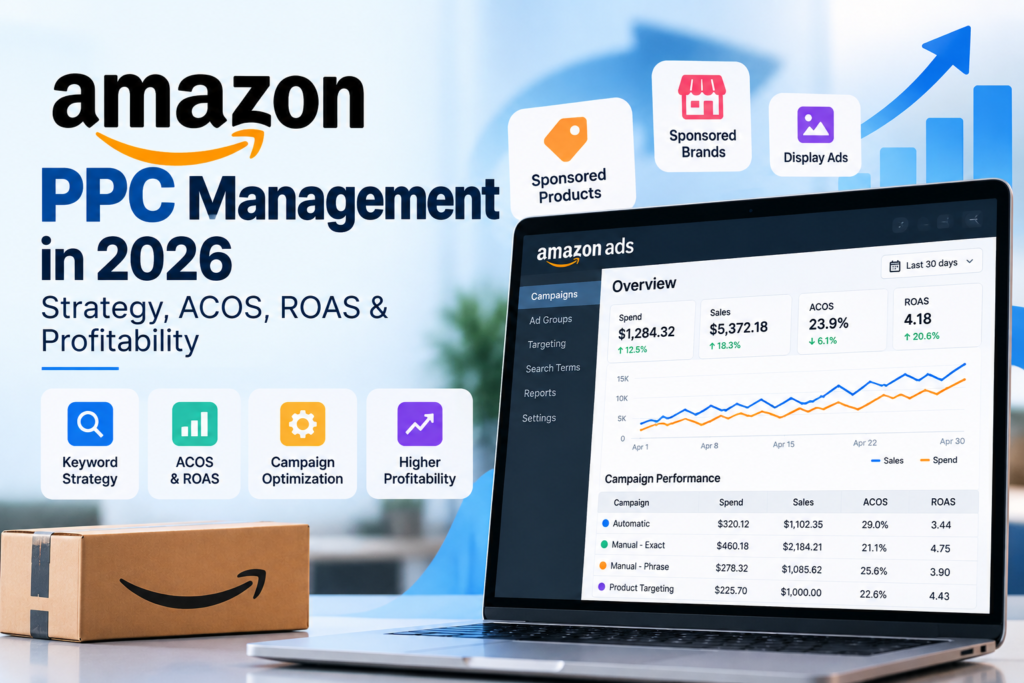
Turning on an Amazon ad campaign takes about five minutes. Running one profitably, month after month, is a completely different skill and it’s where most sellers actually lose money without realizing it.
Amazon PPC management isn’t a one-time setup. It’s an ongoing process of keyword research, bid adjustments, search term analysis, and budget reallocation that directly affects your sales, your organic visibility, your TACOS, and ultimately how much profit you keep. Advertising spend that looks fine at a glance sales are up, campaigns are “active” can still be quietly wasting a meaningful share of your budget on keywords and placements that never should have been funded in the first place.
This guide walks through how Amazon PPC actually works in 2026: campaign structure, keyword targeting, bidding logic, and the metrics that matter ACOS, ROAS, TACOS, and break-even ACOS along with how to connect advertising performance to real business profitability rather than treating it as a number in isolation. Whether you’re running your first campaign or managing PPC across a multi-SKU, multi-marketplace catalog, the goal here is the same: understand what’s actually driving your numbers, not just react to them.
What Is Amazon PPC Management?
Amazon PPC (pay-per-click) advertising lets sellers bid to have their products appear in prominent placements search results, product pages, and increasingly, AI-generated shopping recommendations paying only when a shopper clicks.
PPC management is everything required to run that advertising effectively over time: campaign creation, keyword research, campaign structure, bid management, budget management, search term analysis, negative keyword management, placement optimization, performance analysis, and continuous optimization.
It has to be ongoing rather than a one-time setup because customer search behavior shifts, competitors adjust their own bids, seasonality changes demand, and new launches change what’s actually converting. A campaign optimized three months ago isn’t guaranteed to still be optimized today.
Why Amazon PPC Management Matters in 2026
Competition continues to increase. More sellers and more sophisticated advertisers mean the cost of winning visibility through advertising tends to rise in competitive categories over time.
Advertising placements are expanding into new surfaces. With Amazon’s AI-assisted shopping features rolling out more broadly, Sponsored Products placements now appear within AI-generated product recommendations, not just traditional search results a new opportunity that also requires monitoring.
Paid and organic performance interact, but they are not the same mechanism. Running PPC does not directly purchase or increase your organic ranking. Advertising can generate sales velocity, reviews, and search-term data that may indirectly support organic performance over time but treating PPC spend as a shortcut to organic rank misunderstands how the two systems relate.
Profitability pressure is real. Rising advertising, product, and fulfillment costs mean sales growth alone doesn’t guarantee profit growth. PPC has to be evaluated against actual margin, not sales volume.
Budget allocation matters more as spend scales. A seller spending $500 a month can absorb some inefficiency; a seller spending $50,000 a month cannot small percentage inefficiencies become large dollar amounts at scale.
First-party Amazon data is a genuine advantage. Search term reports and conversion data by keyword come directly from Amazon’s own systems, giving sellers buyer-intent data that’s difficult to access elsewhere in ecommerce.
Amazon Advertising Types You Need to Know
Sponsored Products
Sponsored Products are ads for individual product listings (ASINs), appearing within search results and on product detail pages the most commonly used format and generally the starting point for most sellers’ advertising strategy.
They’re available to any seller with a Professional selling plan and Buy Box eligibility Brand Registry enrollment isn’t required, making this format accessible to newer sellers. Targeting can be by keyword (automatic or manual) or by product. Because these ads pull your existing listing content automatically (main image, title, price), ad quality is directly tied to listing quality a weak listing undermines even well-targeted campaigns.
Sponsored Brands
Sponsored Brands are banner-style ads showcasing your brand logo, a custom headline, and multiple products, appearing prominently in search results, often above Sponsored Products. Unlike Sponsored Products, they drive traffic to a Brand Store or custom landing page rather than a single product page.
This format requires active Brand Registry enrollment and a live Brand Store. As of 2026, three creative formats are available: Product Collection (multiple products with a custom headline), Video, and Brand Video (an evolution of what was previously called Store Spotlight). It’s especially useful for brands with more than one relevant product in a category, letting you own a broader category search with brand identity rather than competing purely listing-by-listing.
Sponsored Display
Sponsored Display is Amazon’s audience-based format instead of keywords, it targets shoppers based on behavior signals, including people who viewed your product pages or added items to cart without purchasing. Ads can appear on Amazon and off Amazon, across sites and apps in Amazon’s ad network.
This makes it functionally different from the other two formats: built for retargeting and audience expansion rather than capturing active search intent. It’s generally available to Brand Registry enrolled sellers, vendors, and their agencies, and is evaluated more on audience segment performance than search term data.
How to Build an Amazon PPC Campaign Structure
A clear campaign structure is what makes performance data actually usable. If everything is mixed into a handful of broad campaigns, you can see that money is being spent, but not where or why it’s working (or not).
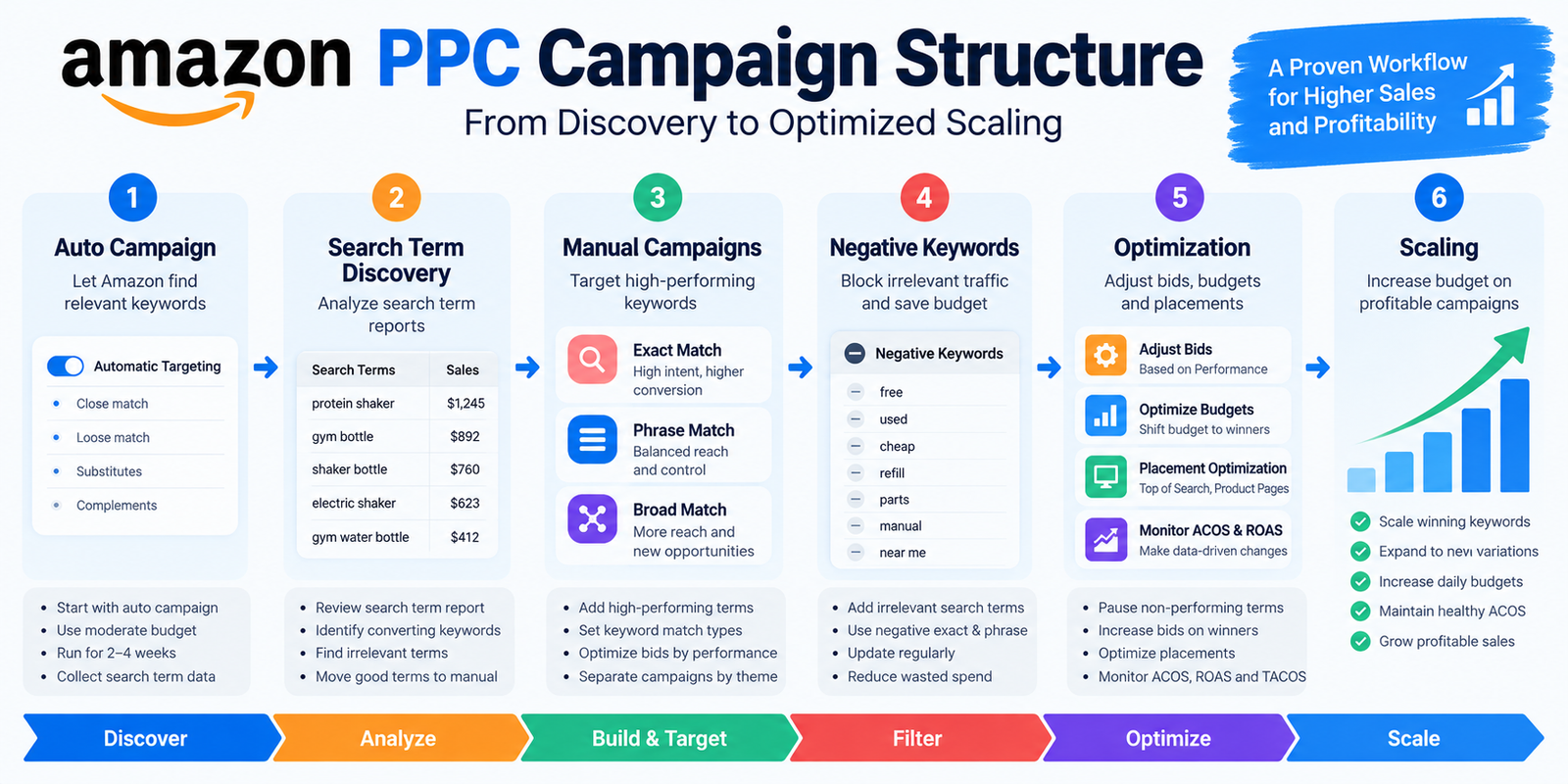
Key building blocks:
Automatic campaigns Amazon selects keywords and placements based on your listing content. Useful for discovering new converting search terms you hadn’t considered, especially early on.
Manual campaigns you select specific keywords or products to target, with full control over match type and bids.
Exact match ads only trigger for the precise keyword phrase (or very close variants), giving maximum control and typically the highest relevance.
Phrase match ads trigger for searches containing your keyword phrase in order, with additional words before or after.
Broad match ads trigger for a wider range of related searches, useful for discovery but requiring closer monitoring, since Amazon’s broad and phrase match matching has been expanding to cover a wider range of related queries making active negative keyword management more important than it used to be.
Product targeting targeting specific ASINs or categories directly, placing your ad on relevant competitor or complementary product pages.
Branded vs. non-branded targeting separating campaigns that target your own brand name (defensive, typically efficient) from campaigns targeting generic or competitor terms (typically more expensive, but necessary for new customer acquisition).
Discovery vs. performance campaigns discovery campaigns (often automatic or broad match) are built to surface new keyword opportunities; performance campaigns (typically exact match) are built to scale what’s already proven to convert.
A practical example structure for a single product:
| Campaign | Type | Purpose |
|---|---|---|
| Campaign 1 | Auto – Discovery | Surface new search terms and placement data |
| Campaign 2 | Manual Exact – High Intent | Scale proven, converting keywords with tight control |
| Campaign 3 | Manual Phrase – Research | Capture related search variations |
| Campaign 4 | Manual Broad – Discovery | Cast a wider net for keyword discovery |
| Campaign 5 | Product Targeting | Place ads on relevant competitor/complementary ASINs |
| Campaign 6 | Branded | Defend your own brand searches efficiently |
This structure isn’t universal the right setup depends on your product, marketplace, budget, and how mature the listing already is. A brand-new launch with no sales history needs more discovery-weighted campaigns; an established, well-reviewed listing can lean more heavily into Exact and Product Targeting once winning keywords are already known.
Amazon PPC Keyword Research
Effective keyword research goes beyond finding terms with high search volume. What actually matters: relevance (does it genuinely reflect the product?), search intent (ready to buy vs. still researching), search volume (a demand indicator, not a conversion guarantee), competition (affects cost per click), conversion history (more reliable than any external estimate once you have real data), search term reports (ground truth for what customers actually searched), existing organic rankings (less aggressive paid investment may be needed where you already rank well), and competitor/product targeting opportunities.
It’s useful to think in categories: high-intent keywords (specific phrases indicating a shopper is close to buying), discovery keywords (broader terms for finding new traffic), branded keywords (your own brand name), competitor keywords, and long-tail keywords (lower volume, often higher conversion intent).
Search volume figures vary across tools and change over time treat any third-party number as directional rather than exact. Amazon’s own search term reports, generated from your actual campaign data, are the most reliable source once a campaign has enough history.
Exact vs Phrase vs Broad Match
| Match Type | Purpose | Best Use | Risk | Example |
|---|---|---|---|---|
| Exact | Maximum precision and control | Scaling proven, converting keywords | Limited reach — misses variations | Keyword: “insulated water bottle 32oz” only matches that phrase and very close variants |
| Phrase | Moderate control with some flexibility | Capturing related searches around a core phrase | Can match broader queries than intended if Amazon expands matching | “insulated water bottle” can match “best insulated water bottle for hiking” |
| Broad | Maximum reach and discovery | Early-stage keyword discovery, new launches | Highest risk of irrelevant traffic; requires active negative keyword management | “water bottle” can match a wide range of loosely related searches |
Amazon has increasingly matched broad and phrase keywords to a wider range of search queries than in the past, which means negative keyword management has become a bigger part of keeping broad and phrase campaigns efficient than it used to be.
Automatic vs Manual Amazon PPC Campaigns
| Factor | Automatic Campaigns | Manual Campaigns |
|---|---|---|
| Targeting control | Amazon selects keywords/placements | You select specific keywords or products |
| Best for | Discovery, search term harvesting, new launches | Scaling known winners, precise budget control |
| Bid control | Limited to targeting group-level bids | Keyword-specific or product-specific bids |
| Data value | Reveals new search terms you hadn’t considered | Provides clean, attributable performance data per keyword |
| Maintenance | Lower setup effort, ongoing search term review still required | Higher setup effort, more precise ongoing optimization |
In practice, these work best together rather than as an either/or choice: automatic campaigns surface new converting search terms through real customer behavior, and those proven terms get “harvested” into manual Exact campaigns where you can control bids and budget with precision. Relying on only one type leaves either discovery or control on the table.
How Amazon PPC Bidding Works
Your bid is the maximum you’re willing to pay for a click, but the actual price and whether your ad wins placement depends on several factors together: bid amount, daily/campaign budget, competing bids, keyword relevance, and where Amazon’s systems account for it conversion signals from your listing’s history.
Simply raising bids across the board isn’t a reliable strategy. Higher bids can increase visibility, but if the keyword or placement isn’t converting, you’re just paying more for the same inefficiency. A more effective approach: lower bids on inefficient targets (clicks without conversions), raise bids on profitable targets (strong conversion history, acceptable ACOS relative to margin), reallocate budget toward proven performers rather than just adding total spend, and adjust for placement-level performance where that data is available.
No bidding strategy can promise a specific outcome the right bid depends on your margin, category competition, and conversion rate, which is why bidding needs ongoing, data-driven attention rather than a one-time setting.
ACOS vs ROAS vs TACOS
These three metrics get used interchangeably by sellers, but they measure different things.
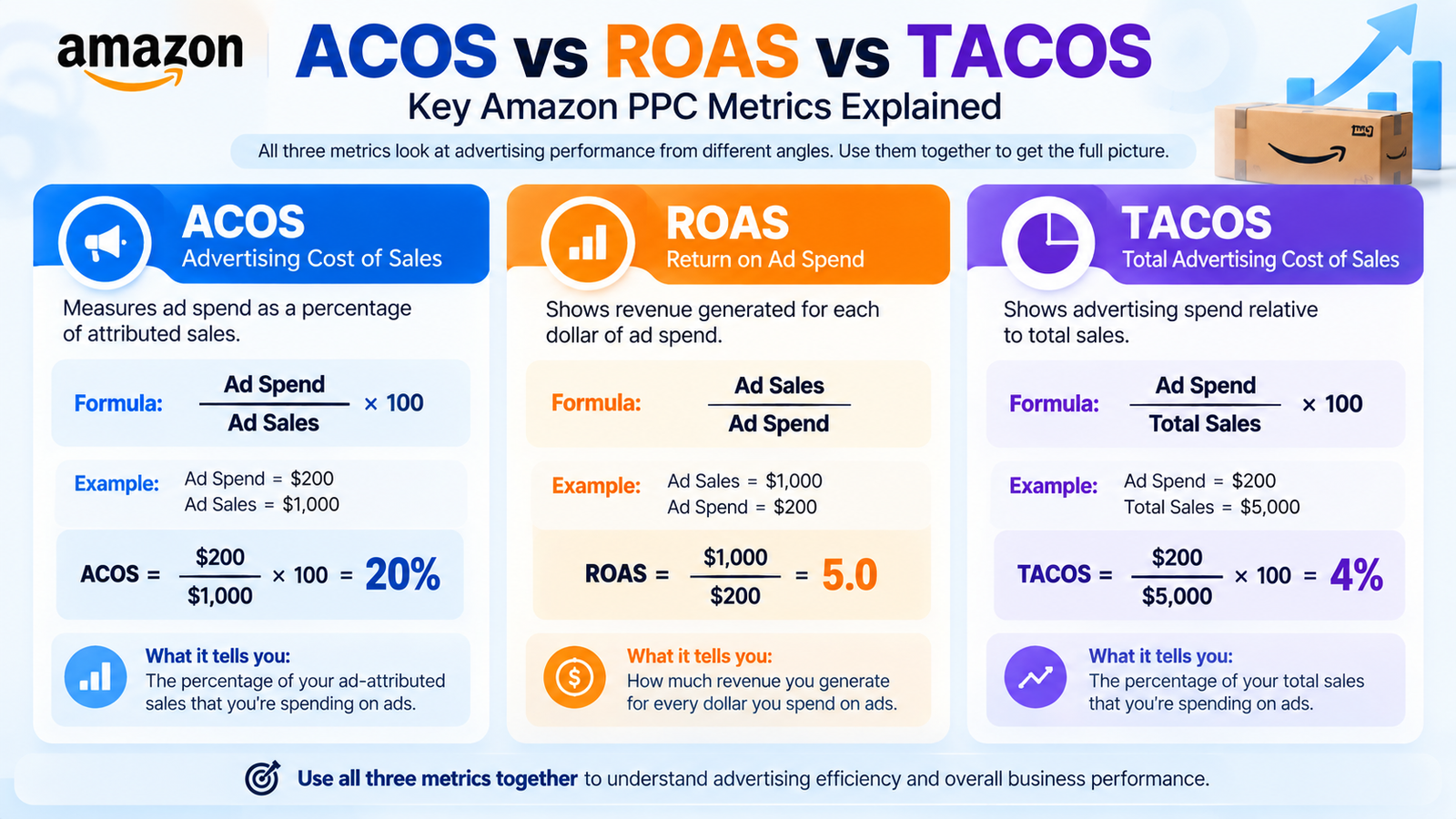
ACOS (Advertising Cost of Sales) = (Ad Spend ÷ Ad-Attributed Sales) × 100
ROAS (Return on Ad Spend) = Ad-Attributed Sales ÷ Ad Spend
TACOS (Total Advertising Cost of Sales) = (Ad Spend ÷ Total Sales, including organic) × 100
Simple example:
$1,000 in ad-attributed sales, $200 in ad spend.
- ACOS = ($200 ÷ $1,000) × 100 = 20%
- ROAS = $1,000 ÷ $200 = 5x
If this same product generated $3,000 in total sales that month (the $1,000 in ad-attributed sales plus $2,000 in organic sales), TACOS = ($200 ÷ $3,000) × 100 = 6.7%.
Why ACOS alone doesn’t tell the whole profitability story: ACOS only measures advertising efficiency relative to ad-attributed revenue — it says nothing about your actual profit margin. A 20% ACOS can be highly profitable on a product with a 50% gross margin, and unprofitable on a product with a 15% gross margin. ACOS is a useful campaign-level efficiency metric, but it has to be read alongside your actual cost structure to mean anything about real profitability. TACOS is useful for understanding how dependent your overall business is on advertising, since it accounts for organic sales that ACOS ignores entirely.
What Is Break-Even ACOS?
Break-even ACOS is the advertising cost percentage at which a sale generates exactly zero profit beyond this point, you’re paying more in advertising than the sale contributes in margin.
To calculate it, you need your contribution margin what’s left from a sale after product cost, Amazon fees, fulfillment fees, and other variable costs, before advertising is subtracted.
Break-Even ACOS = Contribution Margin ÷ Selling Price × 100
Worked example:
A product sells for $30.
- COGS (landed cost): $8
- Amazon referral fee (15%): $4.50
- FBA fulfillment fee: $6.00
- Other variable costs (storage, returns allocation): $1.50
Contribution margin = $30 − $8 − $4.50 − $6.00 − $1.50 = $10.00
Break-even ACOS = ($10.00 ÷ $30.00) × 100 = 33.3%
This means any ACOS below 33.3% generates some profit on this specific product; any ACOS above it means the sale is losing money once advertising is factored in.
Target ACOS is typically set below break-even to leave a healthy margin, depending on your profitability goals. Actual ACOS is simply what campaigns are currently achieving, and should be compared against both break-even and target not evaluated alone.
Break-even ACOS varies significantly by product, since it depends entirely on that product’s cost structure. A universal “good ACOS” benchmark doesn’t exist what’s profitable for one product can be a loss for another at the exact same ACOS percentage.
How to Optimize Amazon PPC Campaigns
A structured optimization framework, reviewed regularly:
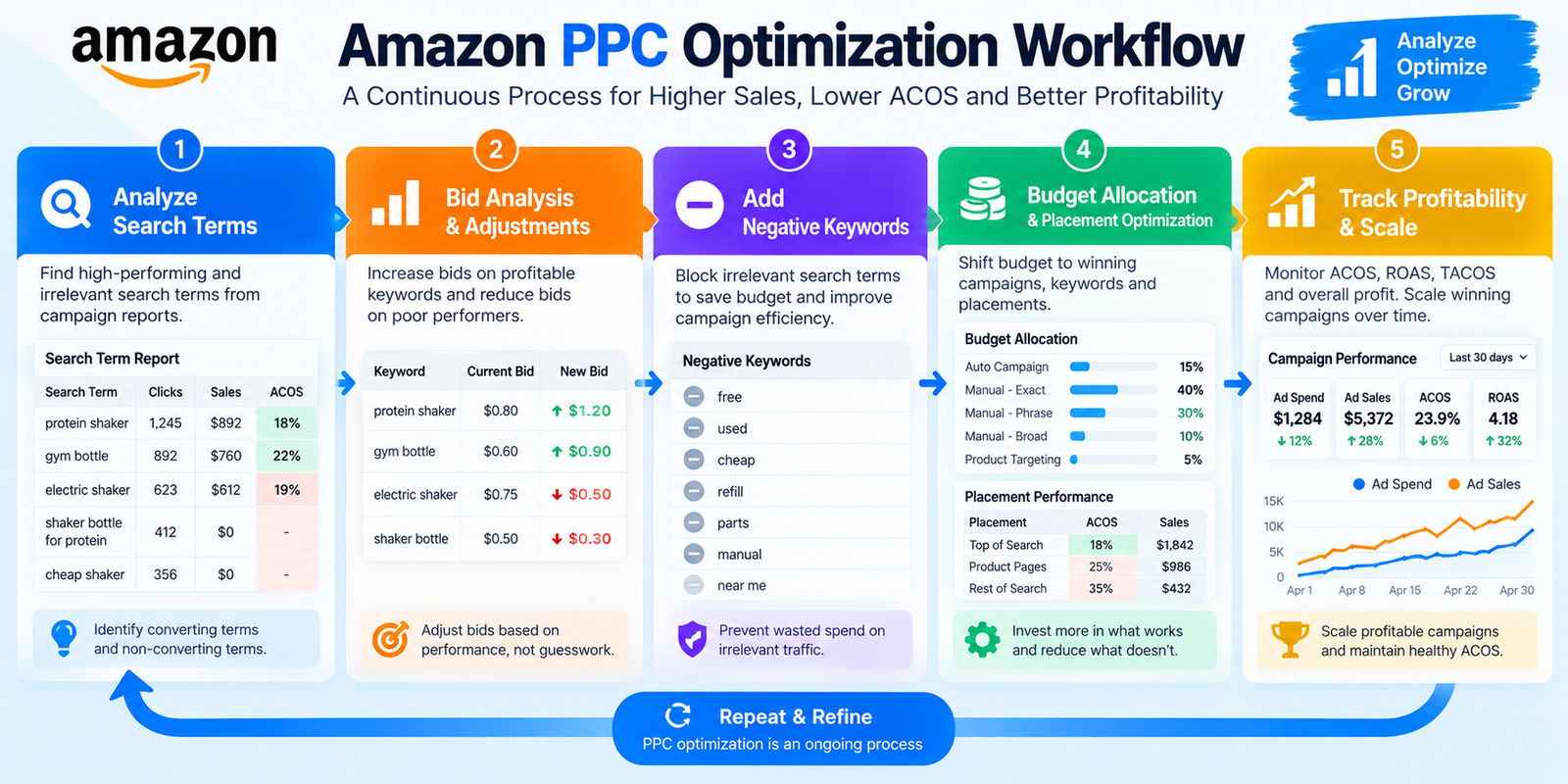
- Search term analysis check what customers actually searched. Look for high-spend terms with no conversions, or unexpectedly relevant terms not yet targeted directly.
- Keyword harvesting move proven-converting terms from automatic/broad campaigns into dedicated manual Exact campaigns.
- Negative keyword management add irrelevant or non-converting terms as negatives to stop wasted spend.
- Bid adjustments raise bids on efficient keywords, lower bids on ones burning budget without results.
- Budget reallocation shift spend toward proven performers rather than spreading budget evenly.
- Placement analysis where placement-level data is available, check whether specific placements under- or over-perform.
- Campaign segmentation keep campaigns organized clearly enough (by match type, intent, or product) that performance data is interpretable.
- Product targeting optimization review which competitor/complementary ASINs convert well versus waste spend.
- Branded vs. non-branded analysis evaluate separately, since the two typically carry very different efficiency expectations.
- Profitability analysis the final check: does campaign-level performance actually translate to acceptable product-level profit?
For more guidance, see Amazon Ads’ Sponsored Products best practices for targeting, bids, budgets, reporting, and campaign optimization.
How to Reduce Wasted Amazon PPC Spend
Wasted spend typically comes from a handful of recurring sources: irrelevant search terms triggering ads through broad or phrase match without a matching negative keyword, poor-converting targets that generate clicks but rarely convert, excessive bids where a lower bid would achieve similar visibility, duplicate targeting where the same keyword is bid on across multiple campaigns competing against itself, weak campaign segmentation that obscures which keywords or products are actually responsible for results, poor listing conversion that wastes even well-targeted traffic, and low-value discovery campaigns left running indefinitely without review.
One important nuance: low ACOS doesn’t automatically mean a campaign is good, and high ACOS doesn’t automatically mean it should be cut. A low-ACOS campaign might be heavily weighted toward branded searches that would have converted organically anyway. A higher-ACOS campaign might be intentionally running at a loss during a launch to build review volume a reasonable short-term strategy depending on the broader goal. Context what the campaign is actually meant to achieve matters more than the number alone.
Amazon PPC and Listing Conversion
PPC’s job is to generate qualified traffic. Whether that traffic converts is largely determined by the listing itself, not the ad one of the most commonly overlooked connections in PPC management, where sellers troubleshoot campaigns when the real issue sits on the product page.
Key listing factors that affect PPC efficiency: title (clarity and relevance), images (main image and supporting stack), bullet points (specific, benefit-focused content), A+ Content (for eligible brands), pricing (competitive positioning), reviews (volume and rating), Buy Box (losing it undermines PPC performance since ads may spend without converting), and overall product-market fit no listing optimization fully compensates for a product that doesn’t meet the need the keyword implies.
If campaigns generate clicks at a reasonable cost but conversion is weak, the fix usually isn’t a PPC adjustment it’s a listing review. This is why Amazon listing optimization and PPC management are so closely connected in practice.
Amazon PPC and Profitability
Advertising metrics only mean something when they’re connected to the underlying economics of the product and business. The full picture includes:
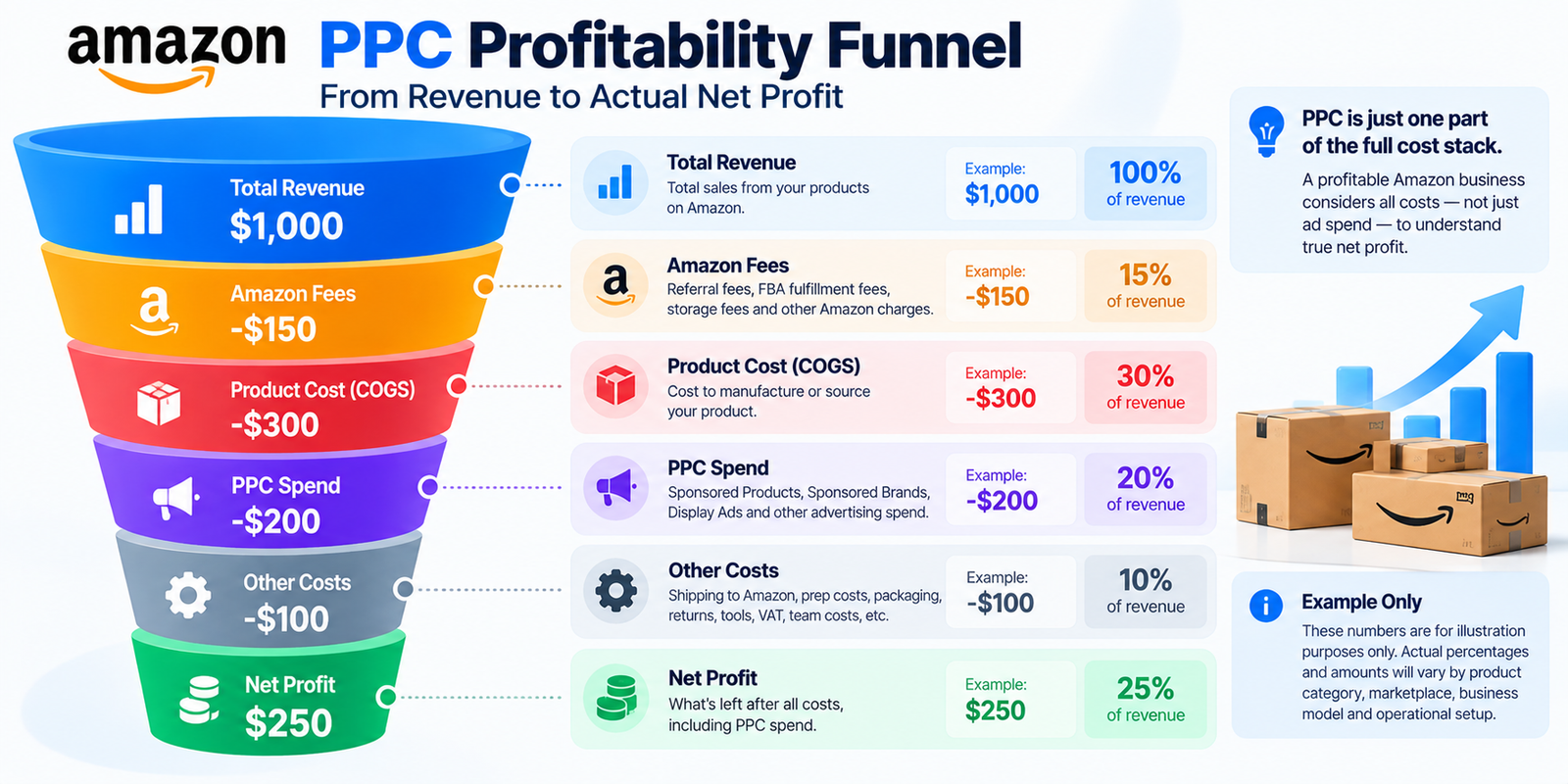
- Revenue total sales generated
- COGS landed product cost, not just manufacturing price
- Amazon fees referral fees and category-specific charges
- FBA fees fulfillment costs based on size and weight
- PPC spend advertising cost per unit or per campaign
- Storage monthly and, where applicable, aged inventory costs
- Returns processing costs and lost sellable value
- Other costs prep, packaging, and any additional operating expenses
- Net profit what’s actually left after every cost above
- Profit margin net profit as a percentage of revenue
Reviewing ACOS or ROAS without this fuller picture can be misleading. A campaign that looks efficient by advertising metrics alone can still be part of a product that’s barely profitable, or not profitable at all, once every cost is included. For a full breakdown of how to calculate this properly, our Amazon profit margin calculator guide walks through the complete formula with worked examples.
Amazon PPC for 7-Figure Brands
PPC management gets meaningfully more complex as a brand scales past six figures into seven-figure territory: more SKUs mean more campaigns and profitability profiles to track simultaneously; larger budgets require more structure since a 5% inefficiency on $50,000 is very different from the same percentage on $2,000.
Multiple marketplaces each carry their own competitive dynamics and cost structures; brand vs. non-brand segmentation becomes more important to track separately; SKU-level profitability matters because account-wide ACOS or TACOS can mask individual products quietly losing money; inventory constraints mean scaling ad spend on a product at risk of stocking out can create more problems than it solves; seasonal demand requires proactive planning rather than reactive adjustment; new launches need separate evaluation from steady-state SKUs; portfolio-level budget allocation means distributing spend by contribution margin and priority, not evenly; and forecasting connects PPC planning to broader inventory and cash-flow decisions.
The core point: a 7-figure brand evaluating PPC only at the account level misses the detail that actually drives decisions. Portfolio-wide numbers can look healthy while individual products or campaigns quietly underperform. Our guide on how to build a 7-figure Amazon brand covers this broader strategic layer in more depth.
Amazon PPC Management Across Multiple Marketplaces
Selling across multiple Amazon marketplaces the US, Canada, the UK, Germany, France, Italy, Spain, the Netherlands, and others means PPC strategy can’t be copied and pasted from one marketplace to the next. Search behavior, competitive intensity, pricing expectations, fee structures, and conversion rates can all differ meaningfully by marketplace, along with currency and cultural differences in how shoppers search.
The practical implication: campaigns should be built and evaluated marketplace by marketplace. What works as a bidding strategy or keyword set in one marketplace is a starting hypothesis for another, not a guaranteed match.
Amazon PPC for New Product Launches
A practical framework for launch-phase PPC:
Phase 1 Discovery. Run automatic and broad match campaigns to surface which search terms drive relevant traffic to a brand-new listing with no performance history.
Phase 2 Data collection. Let campaigns run long enough to generate meaningful search term and conversion data rushing this means optimizing on too little information.
Phase 3 Keyword harvesting. Move proven-converting terms into dedicated manual Exact campaigns.
Phase 4 Optimization. Apply the broader framework covered earlier bid adjustments, negatives, budget reallocation.
Phase 5 Scaling. Increase budget and bids on what’s proven to convert, while continuing to test newer campaigns.
Throughout, launch PPC performance is closely tied to listing quality, review volume, inventory availability, and genuine conversion rate advertising can generate traffic, but it can’t manufacture demand for a listing that isn’t ready to convert it. No launch framework can promise a specific ranking or sales outcome.
Common Amazon PPC Mistakes
- Optimizing only for ACOS without checking whether that ACOS is actually profitable for the specific product
- Ignoring profit margin entirely when making PPC decisions, treating advertising metrics as the whole picture
- Setting bids once and never reviewing them again, even as competition and performance shift over time
- Ignoring search term data, missing both wasted spend and new keyword opportunities hiding in the reports
- Not using negative keywords, letting irrelevant traffic continue draining budget indefinitely
- Poor campaign segmentation, making it impossible to tell which keywords or products are actually driving results
- Mixing unrelated products into the same campaign, which muddies performance data and bid strategy
- Ignoring inventory when scaling ad spend, risking a stockout that wastes the momentum just built
- Sending traffic to weak listings, paying for clicks a poorly optimized product page can’t convert
- Scaling budget before profitability is actually understood, compounding losses rather than compounding profit
- Treating every keyword the same, applying identical bid strategy to high-intent and pure-discovery terms alike
- Ignoring branded vs. non-branded performance, missing that these two campaign types typically need very different evaluation standards
When Should You Hire an Amazon PPC Agency?
There’s no universal answer it depends on your specific situation. Signs that external PPC management may make sense include:
- PPC complexity has outgrown your available time to manage it properly
- You lack internal expertise in the level of ongoing optimization covered throughout this guide
- Ad spend is growing and even small inefficiencies now represent meaningful dollar amounts
- You’re managing multiple marketplaces, each requiring separate strategy and monitoring
- You have multiple SKUs, making manual, ongoing optimization genuinely time-consuming
- Internal resources are limited, and PPC competes for time against other operational priorities
- You need structured, regular reporting that connects advertising performance to actual business decisions
- You need consistent, ongoing optimization rather than occasional, reactive check-ins
An agency isn’t automatically the better choice for every seller a smaller catalog with a capable, engaged internal owner may manage PPC well without outside help. The decision should be based on whether outside expertise solves a real, specific gap in your current setup.
What Should an Amazon PPC Management Service Include?
A checklist for evaluating what’s actually included in a PPC management offering:
- Account audit before strategy begins
- Campaign strategy tailored to the specific brand and goals
- Campaign creation and structure
- Keyword research
- Targeting strategy (keyword and product)
- Ongoing bid management
- Budget management and reallocation
- Regular search term analysis
- Active negative keyword management
- Placement analysis where data supports it
- Regular performance reporting
- Profitability analysis, not just advertising metrics
- Continuous, ongoing optimization
- Strategy calls or structured reporting check-ins
How to Choose an Amazon PPC Agency
Beyond the service checklist above, evaluate potential partners on:
- Amazon-specific experience not general digital marketing experience
- Relevant marketplace experience matching where you actually sell
- Reporting transparency clear, regular, and genuinely informative rather than a generic template
- Campaign methodology can they explain their actual approach, not just claim results?
- Profitability focus do they talk about margin and contribution profit, or only ACOS and sales?
- Communication a defined process and point of contact
- Case studies where offered, do they reflect situations genuinely similar to yours?
- Contract terms clear scope and clear exit terms
- Scope of work exactly what’s included versus what would cost extra
- Understanding of listing optimization since PPC and listing quality are inseparable in practice
- Understanding of inventory and profitability not just advertising mechanics in isolation
For a more complete framework on evaluating agencies broadly (not just for PPC specifically), see our guide on how to choose an Amazon agency.
Exon Solutionz Amazon PPC Management
Exon Solutionz provides Amazon-focused services including Amazon PPC management, Amazon account management, Amazon SEO, listing optimization, brand management, and creative services. We work with Amazon brands with a focus on structured growth connecting PPC strategy, listing performance, and profitability rather than treating advertising as an isolated function.
Our approach follows the same principles outlined throughout this guide: campaign structure built around actual product and business goals, ongoing search term and bid optimization, and performance reviewed against real profitability not just surface-level advertising metrics.
If you’re evaluating your current PPC strategy or considering outside management, talk to Exon Solutionz about your Amazon PPC strategy.
Amazon PPC Management Checklist
- Run through this regularly for an active PPC account:
- Campaign structure reviewed
- Budgets reviewed
- Search terms analyzed
- Negative keywords updated
- Bids reviewed
- High-performing targets identified
- Low-performing targets identified
- ACOS reviewed
- ROAS reviewed
- TACOS reviewed
- Profit margin reviewed
- Inventory checked
- Listing conversion reviewed
- Brand vs. non-brand performance reviewed
- Marketplace performance reviewed
Frequently Asked Questions
What is Amazon PPC management?
Amazon PPC management is the ongoing process of planning, monitoring, optimizing, and scaling Amazon advertising campaigns. It includes keyword research, campaign structure, bid management, budget allocation, search-term analysis, negative keywords, and performance tracking.
How does Amazon PPC work?
Amazon PPC allows advertisers to promote products through paid advertising where costs can be based on clicks. Advertisers choose products, targeting, bids, and budgets, then use campaign data and reports to optimize performance.
What is a good ACOS for Amazon PPC?
There is no universal ACOS target that works for every Amazon business. A suitable ACOS depends on product margins, selling price, campaign objective, competition, conversion rate, and overall profitability.
What is the difference between ACOS and ROAS?
ACOS measures advertising spend as a percentage of attributed sales, while ROAS measures how much attributed sales revenue is generated for each dollar of advertising spend. Both metrics can help evaluate advertising efficiency from different perspectives.
What is TACOS in Amazon PPC?
TACOS, or Total Advertising Cost of Sales, measures advertising spend against total sales. Unlike ACOS, which focuses on attributed ad sales, TACOS helps connect advertising spend with the broader sales performance of the business.
How often should Amazon PPC campaigns be optimized?
Amazon PPC should be reviewed regularly rather than treated as a campaign that is set up once and left unchanged. Search terms, bids, budgets, placements, conversions, ACOS, ROAS, and profitability can be reviewed on a recurring schedule based on campaign volume and business goals.
How do negative keywords improve Amazon PPC performance?
Negative keywords can prevent ads from appearing for irrelevant or unwanted shopping queries. This can reduce wasted spend and help focus advertising budget on more relevant traffic.
Should Amazon PPC campaigns use automatic or manual targeting?
Automatic and manual targeting can serve different purposes. Automatic campaigns can help discover relevant search terms and products, while manual campaigns provide more control over specific keywords, match types, bids, and targeting.
How can Amazon PPC improve profitability?
PPC profitability depends on more than ACOS alone. Effective management connects advertising performance with product costs, Amazon fees, conversion rate, inventory, listing performance, and overall profit margins.
How should 7-figure Amazon brands manage PPC?
Larger Amazon brands typically need more granular PPC management across SKUs, marketplaces, budgets, search terms, inventory, and profitability. Campaign performance can be evaluated at both the campaign and product level to identify where budget is working and where adjustments may be needed.
When should I hire an Amazon PPC agency?
An Amazon PPC agency may be useful when campaign complexity, advertising spend, multiple SKUs, marketplaces, or ongoing optimization requirements become difficult to manage internally. The right approach depends on the brand’s goals, resources, and existing PPC capabilities.
Final Thoughts
Amazon PPC management is a continuous process, not a campaign you set up once and leave alone. ACOS and ROAS are useful efficiency metrics, but neither tells the complete profitability story on their own that requires connecting advertising performance to your actual cost structure, down to the SKU level. Listing conversion matters just as much as targeting and bidding, since even well-optimized campaigns underperform when they’re driving traffic to a page that doesn’t convert it.
As a brand scales, this only gets more important account-level averages can hide individual products or campaigns that are quietly losing money, which is exactly why larger brands typically need more structured, granular PPC management rather than less. Good PPC management, at any scale, connects advertising decisions to the wider economics of the business rather than optimizing ad metrics in isolation.
If you’d like a second set of eyes on your current PPC strategy, Exon Solutionz is available to talk through where your campaigns and profitability actually stand today.
1 Comment on "Amazon PPC Management in 2026: Strategy, ACOS, ROAS & Profitability"
This was a very helpful guide. I especially liked the sections on ACOS, ROAS, and break-even ACOS because they make PPC profitability much easier to understand.